


News Desk
The News Desk provides timely and factual coverage of national and international events, with an emphasis on accuracy and clarity.
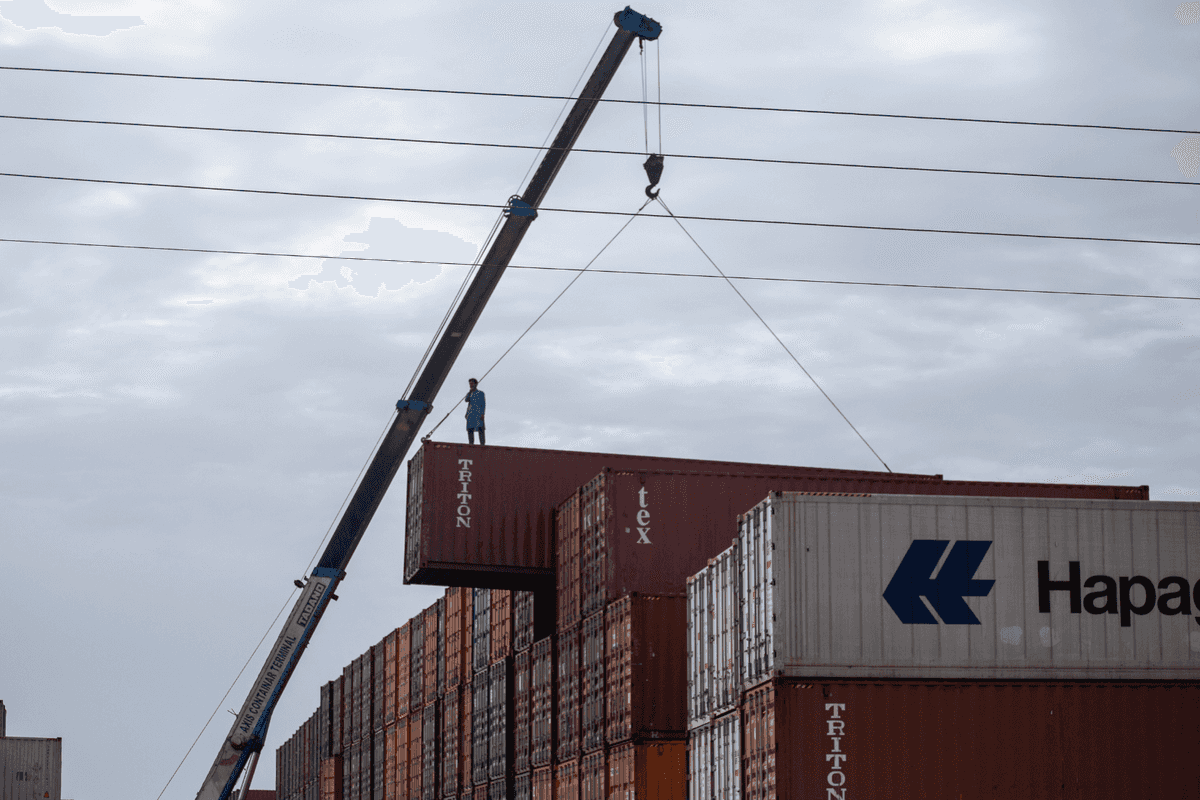
A crane lifts a shipping container in Pakistan.
The United States said Thursday it will impose new tariffs on Pakistan and 59 other trading partners starting Friday, citing forced labor concerns in global supply chains.
The move replaces a temporary global duty President Donald Trump introduced earlier this year.
What is the new US tariff on Pakistan?
Pakistan faces a 10% tariff under the new regime, the same baseline rate applied to economies that have banned or pledged to ban forced labor imports.
The rate takes effect Friday and replaces the temporary 10% duty imposed after the Supreme Court struck down earlier Trump-era tariffs. Other economies at the 10% rate include Canada, the European Union, India and the United Kingdom.
Why is the US imposing these forced labor tariffs?
US Trade Representative Jamieson Greer said Washington has enforced a forced labor import ban for nearly a century and expects trading partners to do the same. He said the 60 targeted economies account for the majority of US trade. Officials said the new tariff regime follows a months-long investigation and is designed to withstand legal challenges better than earlier measures.
The move follows a February Supreme Court ruling that struck down a number of Trump-era tariffs, limiting the administration's ability to impose broad duties. The administration then used separate legal authorities to reimpose a temporary 10% tariff for 150 days, a period that expires Friday. The new regime, first proposed in June, replaces that stopgap measure with duties officials describe as more legally durable.
Which countries face the higher 12.5% tariff rate?
China, Japan, South Korea and dozens of other economies will face a 12.5% tariff rate under the new rules. The European Union, Taiwan, Japan, South Korea and Switzerland will receive some relief tied to existing trade agreements with the United States.
The tariffs will not apply to goods already covered by sector-specific duties, including steel and aluminum, or to certain energy products, fertilizers and goods under the United States-Mexico-Canada Agreement.
Washington is separately investigating 16 economies over what it calls excess industrial capacity, a probe that could lead to further tariffs at varying rates.
Trade lawyer Greta Peisch, a former general counsel at the US Trade Representative's office, said maintaining a baseline tariff while keeping further duties possible gives Washington leverage in negotiations. Peisch said the ongoing investigations are meant to strengthen the legal footing for tariffs if they are challenged in court.
How have trading partners reacted to the tariffs?
Several governments criticized the tariffs shortly after the announcement. Japanese government spokesman Minoru Kihara said Tokyo regrets the higher rate, arguing it was imposed solely because Japan lacks a ban on importing goods made through forced labor. Australian Trade Minister Don Farrell called the tariffs unjustified, saying they conflict with Australia's free trade agreement with the United States.
The European Union, which recently finalized a separate trade pact with Washington, said it expects the United States to honor commitments made in the EU-US Joint Statement. Atlantic Council analyst Josh Lipsky said the tariffs could remain in place through Trump's term and reflect a broader protectionist shift, while also boosting government revenue.
What other US tariffs have been announced recently?
The forced labor tariffs follow a string of other US trade actions in recent weeks. A 25% tariff took effect on various Brazilian goods after Washington accused Brazil of unfair trade practices. Trump also ordered new 50% tariffs on many Canadian products this week, citing what he called discriminatory treatment of US alcohol, automobile and dairy products.
Lipsky said the Canadian tariffs rely on an untested legal provision, suggesting the administration still has other tools to impose duties quickly. He said the move indicates that existing US tariff agreements remain fragile even after they are signed.



Comments
See what people are discussing