

US to close flagship Gaza mission as Trump plan stalls: report
Trump administration plans to shut the Civil-Military Coordination Centre in Israel, handing its duties to a new Gaza security force, sources tell Reuters

News Desk
The News Desk provides timely and factual coverage of national and international events, with an emphasis on accuracy and clarity.
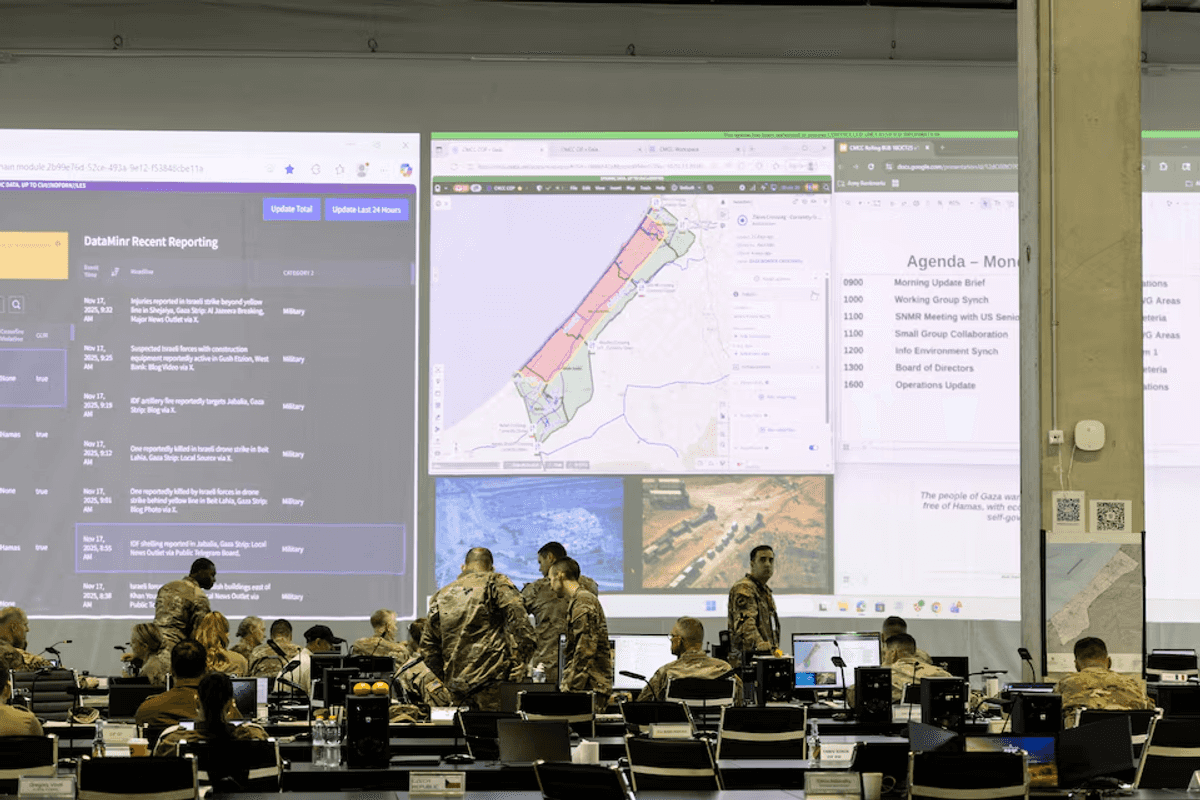
U.S. and Israeli troops meet at the Civil-Military Coordination Centre in southern Israel overseeing Trump’s Gaza plan (Nov 17, 2025).
Reuters
The Trump administration plans to close the Civil-Military Coordination Centre, a US military-run body in southern Israel overseeing the Israel-Hamas ceasefire and aid flows to Gaza, sources told Reuters.
The closure would transfer the CMCC's responsibilities to a US-commanded international security mission. Trump's Board of Peace denied the center was closing, without addressing whether the new force would absorb its role.
What is the CMCC and why is the US closing it?
The Civil-Military Coordination Centre is a US-led body established in southern Israel as a key part of Trump's 20-point Gaza plan. Critics say it failed to enforce the ceasefire or meaningfully boost aid to Palestinians.
Its closure, according to seven diplomats familiar with its operations, reflects the broader stalling of Trump's Gaza strategy amid continued Israeli attacks and Hamas's refusal to disarm.
What will replace the CMCC in Gaza?
The CMCC's aid and monitoring responsibilities are expected to transfer to the International Stabilization Force, a US-commanded security mission intended to deploy to Gaza. Once the handover is complete, the body is expected to be rebranded as the International Gaza Support Centre. It would likely be led by US Major General Jasper Jeffers, the White House-appointed ISF commander.
The number of US troops working within the revamped ISF is expected to drop from around 190 to 40. Washington plans to replace those troops with civilian staff from other countries, the diplomats said. All sources spoke on condition of anonymity because they were not authorised to speak publicly.
Has the Board of Peace responded to the closure reports?
Trump's Board of Peace denied the CMCC was closing in a statement posted on social media after the Reuters report was published. The statement did not address whether the ISF would take over the centre's responsibilities. An earlier Board of Peace official declined to comment on the CMCC's future, but described the centre as playing a "critical role in ensuring aid deliveries and coordinating efforts" under Trump's plan.
The White House and the US military's Middle East command both referred requests for comment to the Board of Peace. US officials have privately described the move as an overhaul rather than a closure. Diplomats, however, said the practical effect would be the same: the CMCC would cease to function as an independent body.
Why has the CMCC lost momentum among allied countries?
Dozens of countries, including Germany, France, Britain, Egypt and the UAE, initially sent military planners and intelligence officials to the CMCC to help shape discussions on Gaza's future. But attendance has dropped sharply, with some countries now sending representatives as little as once a month. One diplomat said only a handful of countries regularly showed up.
The ISF has established a walled-off annex inside the CMCC, but access is tightly controlled by US troops who, according to three sources, regularly deny entry to representatives from allied countries. Diplomats say the CMCC also lacked the authority to enforce the ceasefire or ensure aid delivery. Whether folding it into the ISF would have any practical effect on the ground remains unclear.
What is the situation in Gaza since the ceasefire?
More than 800 Palestinians and four Israeli soldiers have been killed since the ceasefire took effect, which was meant to halt a war triggered by the Hamas-led attack on Israel on 7 October 2023.
Israel has continued to carry out strikes and push its armistice line deeper into Gaza, while Hamas has reassumed governance over a coastal slice of territory under its control. Palestinians say the ongoing Israeli advances are a pretext to seize land they seek for a future state. Israel says its actions are aimed at stopping threats from Hamas and people approaching the armistice line.
Aid levels have remained largely stagnant despite a rise in commercial goods entering Gaza, with Israel banning items it says carry dual military and civilian uses.
Restricted goods include tent poles for displaced persons camps and heavy machinery needed to clear rubble. COGAT, the Israeli military agency controlling access to Gaza, said 80 percent of trucks entering daily carried commercial goods purchased in Israel, describing them as supplementary to humanitarian supplies.





Comments
See what people are discussing