

Viral video does not show Saudi Arabia intercepting Houthi drone over Makkah
A viral video claiming Saudi forces intercepted a Houthi drone over Makkah is false, iVerify Pakistan found, tracing it to 2025 Madinah footage.

Fact Check By Iverify
iVerify Pakistan is an independent fact-checking initiative dedicated to combating misinformation and promoting truth in the digital age.
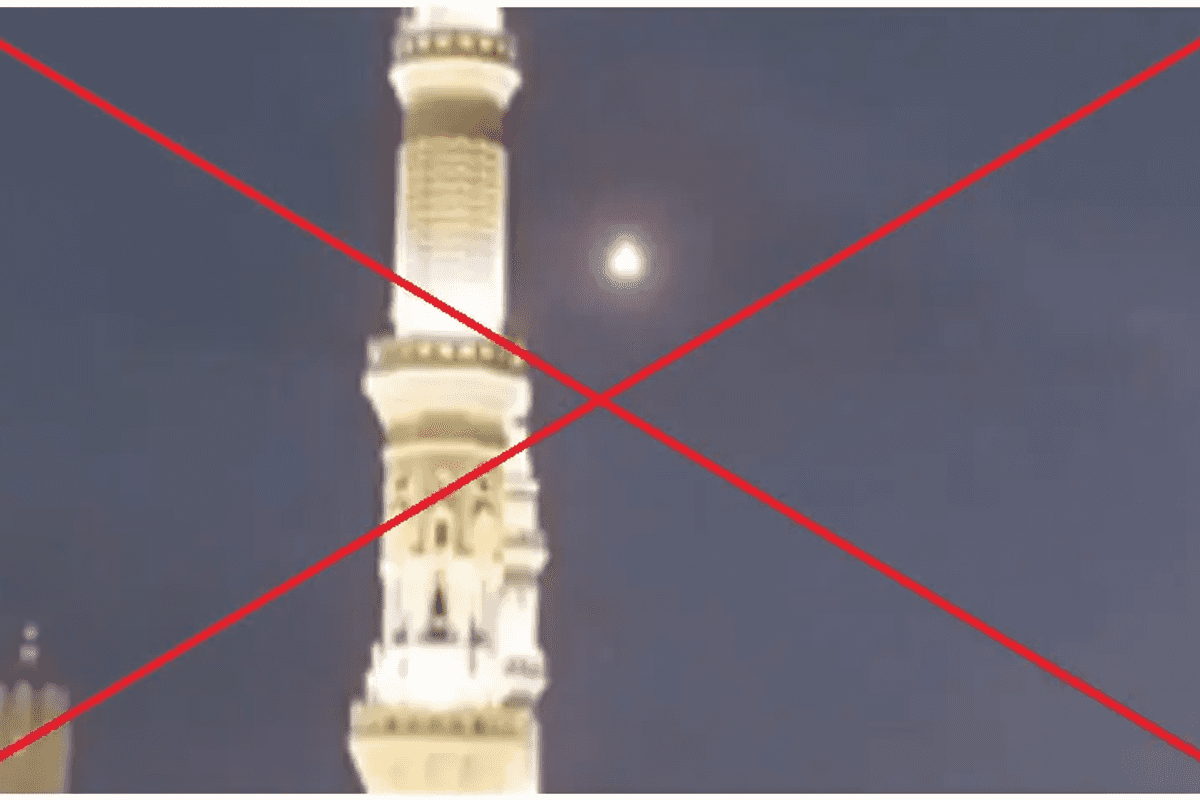
iVerify Pakistan found the footage was filmed near Masjid an-Nabawi in Madinah in September 2025.
Screengrab
A viral video circulating on social media does not show Saudi air defenses intercepting a Houthi drone over Makkah, according to an iVerify Pakistan fact-check. The footage actually dates to September 2025 and shows a missile-like object in the sky over Madinah, not this week's reported interception.
Does the viral video show a drone intercepted over Makkah?
No. iVerify Pakistan found the footage was filmed near Masjid an-Nabawi in Madinah in September 2025, more than a year before the suspected Houthi drone incident this week. Reverse-image and keyword searches traced it to earlier posts describing a missile-like object, not the drone Saudi forces intercepted south of Makkah on Sept. 15, 2026.
How did the false Makkah drone claim spread?
Multiple users began sharing the video on X on Sept. 16, 2026, claiming it showed Saudi air defenses intercepting a Houthi drone after it entered Makkah's airspace. Journalist Ahmed Quraishi's post received 3 million views, while another post making a similar claim gained 145,000 views. Several other X users shared the same footage, collectively receiving 34,962 views.
Quraishi's caption read: "Breaking: Saudi Air Defence intercepted and destroyed a drone that entered Makkah's airspace." It added that the Saudi-led coalition called the attempt "a black mark in the record of Houthi violations" and described the security of the holy sites as "a red line."
What actually happened near Makkah?
The claim emerged amid renewed tensions between Saudi Arabia and Yemen's Houthi movement, following a period of relative calm after the 2022 truce. The Houthis have recently carried out missile and drone attacks on Saudi territory, prompting an intensified Saudi military response.
On Sept. 15, Saudi authorities said their air defenses intercepted and destroyed a Houthi drone south of Makkah before it entered the holy city's restricted airspace. Saudi-led coalition spokesperson Turki Al-Malki called it the second reported attempt to target Makkah, after a 2017 ballistic missile launch, and said the security of the Two Holy Mosques was "a red line." The Houthis denied targeting Makkah or any other Islamic holy site.
How did iVerify Pakistan trace the video's real origin?
iVerify Pakistan first ran keyword searches to check whether credible Saudi or international outlets had linked the footage to the Makkah incident, and found no matching reports. A reverse-image search then traced the video to a Facebook post by Islam Channel from Sept. 12, 2025, whose caption cited witnesses reporting an explosion near Masjid an-Nabawi in Madinah and a missile-like object in the sky, with no official confirmation at the time.
The same footage appeared on Muslim News's Instagram in September 2025, with a caption saying Saudi Arabia had intercepted a missile near Masjid an-Nabawi and speculating it may have been a Yemeni missile headed toward Israel. A separate Sept. 16, 2025, post by Inside the Haramain, an unofficial outlet covering the Grand Mosque and the Prophet's Mosque, said a source described an unauthorized drone intercepted near Madinah at about 5:40 a.m. that Thursday.
Recent reports by The Guardian, Al-Jazeera, CNN, Deutsche Welle and Reuters on the actual Makkah incident said the drone was intercepted south of the city before entering restricted airspace, contradicting the viral video's caption claiming the drone had already entered Makkah's airspace. iVerify Pakistan said the fact-check was prompted by the video's high virality and public interest in the security of the holy sites, and concluded the claim is false.
This fact check was originally published by iVerify Pakistan - a project of IBA-CEJ and UNDP.





Comments
See what people are discussing