

King Charles urges US-UK unity amid Iran tensions and global instability
Charles III addressed a joint session of Congress, calling for US-UK unity on democracy, Ukraine and Western alliances

News Desk
The News Desk provides timely and factual coverage of national and international events, with an emphasis on accuracy and clarity.
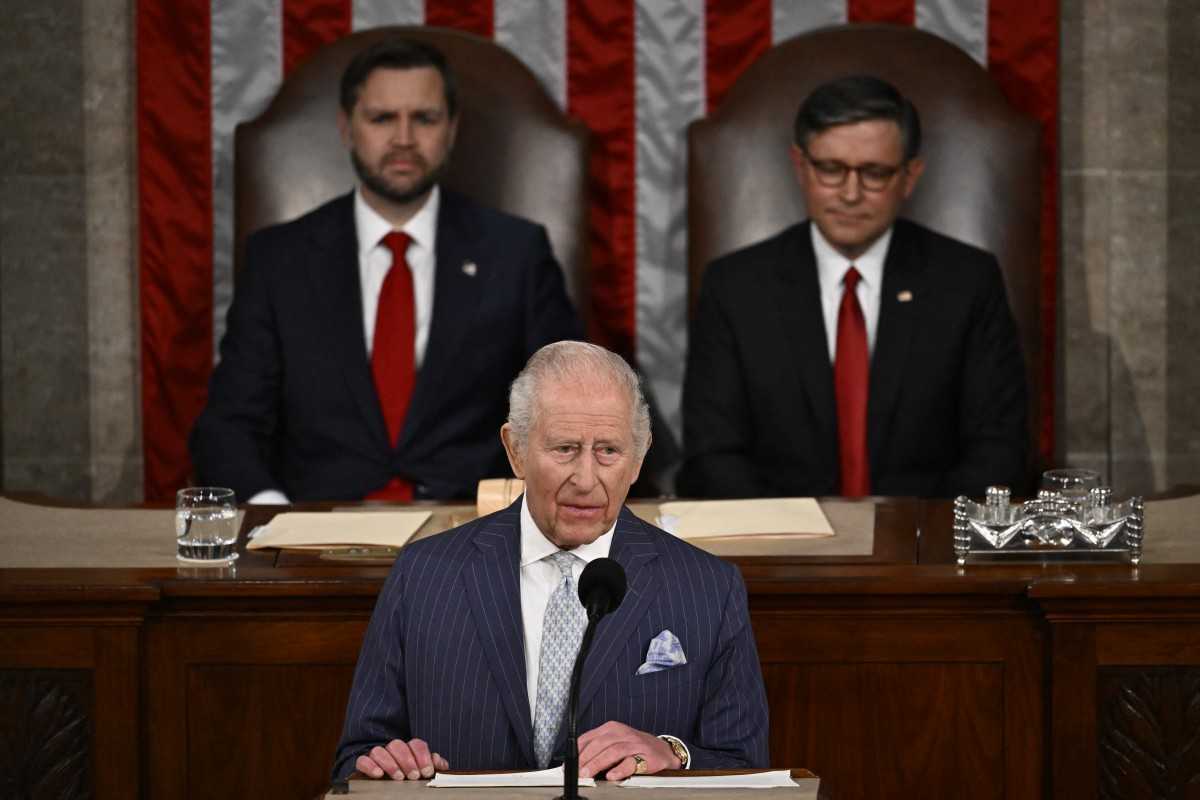
King Charles III addresses a joint meeting of Congress as JD Vance and Mike Johnson look on at the U.S. Capitol on April 28, 2026.
AFP
King Charles III addressed a joint session of the U.S. Congress on Tuesday, calling on Britain and the United States to remain steadfast partners in defending democratic values.
The speech came during a four-day state visit, at a time when the alliance has been strained by disagreements over the conflict with Iran. Charles received a prolonged standing ovation upon entering the chamber alongside Queen Camilla.
What did King Charles say in his address to Congress?
Charles told lawmakers that both nations were bound by a shared commitment to security and democratic principles, despite policy differences.
He invoked the history of U.S.-UK cooperation, including joint responses to the September 11 attacks, and framed continued support for Ukraine as part of a broader defense of shared security interests. He also urged both countries to protect natural resources for future generations.
Why did Charles caution against isolationism in his Congress speech?
Although Buckingham Palace had indicated the speech would avoid politics, Charles made indirect references to several contested geopolitical issues. He called for continued Western support for Ukraine in its war with Russia, stressed the importance of multilateral cooperation, and urged sustained engagement with allies across Europe and the Commonwealth.
His remarks were widely interpreted as alluding to positions taken by Donald Trump, who has criticized NATO allies and questioned long-term support for Ukraine.
Charles also appeared to caution against inward-looking policies, a comment widely read as a subtle rebuttal to nationalist political trends. The speech marked only the second time a British sovereign has addressed Congress, following Queen Elizabeth II in 1991. His environmental remarks drew a more muted response from some Republican lawmakers.
What did Trump say about Iran and King Charles at the White House?
Later, at a state banquet hosted at the White House, Trump said the king shared his view that Iran must not acquire nuclear weapons. Charles did not address Iran directly in his own remarks, consistent with the convention that the British monarch does not speak on behalf of government policy. Neither Downing Street nor Buckingham Palace immediately commented on Trump's statement.
The state visit also included meetings with leading figures from the U.S. technology sector, among them Jeff Bezos, Tim Cook, Jensen Huang, Lisa Su and Marc Benioff, as Britain promotes itself as a hub for innovation and investment. Trump has publicly criticized British Prime Minister Keir Starmer for what he describes as insufficient support over Iran, adding a layer of diplomatic sensitivity to the visit.
What other tensions surrounded King Charles's U.S. state visit?
Geopolitical pressures cast a shadow over the trip beyond the Iran dispute. A reported internal Pentagon communication suggested Washington could reassess its backing of Britain's claim to the Falkland Islands, underscoring the fragility of the current diplomatic climate. The US-UK special relationship, long seen as a cornerstone of Western security, is facing pressure on multiple fronts.
The visit also drew renewed attention to the legacy of Jeffrey Epstein. Charles avoided public discussion of the issue, which involves his brother Prince Andrew, who faces ongoing scrutiny over past associations but denies wrongdoing.
U.S. lawmaker Ro Khanna said the king declined an invitation to meet survivors linked to the case, citing sensitivities around ongoing legal processes.





Comments
See what people are discussing