

Indian analysts acknowledge Pakistan's rising global profile
Kamran Khan examines how Indian commentators and former officials view Pakistan's expanding diplomatic role.

News Desk
The News Desk provides timely and factual coverage of national and international events, with an emphasis on accuracy and clarity.
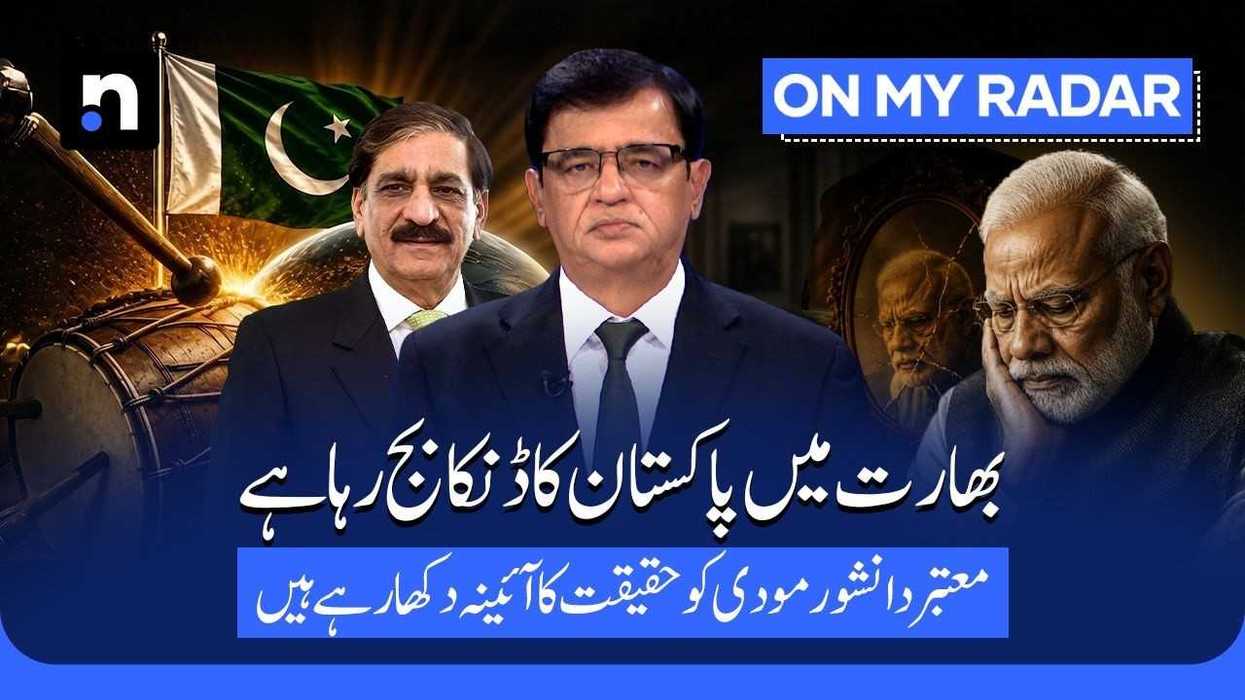
Pakistan's growing diplomatic influence and role in regional security are prompting Indian analysts, former diplomats and political figures to reassess New Delhi's approach toward Islamabad, according to the latest episode of Kamran Khan's On My Radar.
Khan said India once claimed it had diplomatically isolated Pakistan, but argued that recent regional developments have instead elevated Pakistan's international standing while exposing what he described as India's own growing diplomatic isolation.
He cited comments by several Indian analysts who said Pakistan is increasingly being viewed as a "strategic stakeholder" in global affairs. According to Khan, they argued that Pakistan's expanding security profile has significantly strengthened its international position and that the time has come to keep channels for dialogue between India and Pakistan open.
Former Indian Foreign Secretary Kanwal Sibal also acknowledged Pakistan's rising regional security importance, Khan said. Sibal argued that Pakistan's mediation role between the United States and Iran had substantially enhanced its international credibility.
Khan also highlighted remarks by Dattatreya Hosabale, the general secretary of the Rashtriya Swayamsevak Sangh (RSS), the ideological parent organization of India's ruling Bharatiya Janata Party (BJP). In an interview, Hosabale said India should "always remain ready" for dialogue with Pakistan.
According to Khan, reports have also emerged in recent months of unofficial meetings between retired Indian and Pakistani diplomats and former military officials. Similar discussions were reportedly held this week in Sri Lanka and Thailand, signaling that despite continued tensions, there is interest on both sides in keeping communication channels open.
Khan argued that Pakistan, once viewed as a country facing mounting challenges, has emerged as an important player in efforts to promote regional stability. He said Pakistan's mediation in securing a U.S.-Iran peace agreement helped both countries step back from conflict and demonstrated Islamabad's ability to play an effective role during international crises.
He added that Western media described Field Marshal Asim Munir's role as an example of effective backchannel military diplomacy. Khan also noted that U.S. President Donald Trump has publicly referred to Munir as his "favorite field marshal."
According to Khan, Pakistan's diplomatic efforts have enabled it to maintain balanced relations simultaneously with Iran, Saudi Arabia, the United Arab Emirates, Qatar, China and the United States.
He said expanding cooperation among Pakistan, Saudi Arabia, Turkey and Egypt is also taking shape as a new regional strategic grouping. The bloc held its first meeting in Riyadh in March and has since completed four additional rounds of talks, which Khan said signals the emergence of a powerful regional platform outside the Gulf Cooperation Council.
Lt. Gen. (retd) Nasir Janjua, Pakistan's former national security adviser, also appeared on the program to discuss the country's evolving regional role.



Comments
See what people are discussing