

Islamabad tightens security as US-Iran talks set to begin amid fragile ceasefire
Islamabad’s Red Zone has been sealed and a control room set up for real-time monitoring as US-Iran talks begin today and continue tomorrow

News Desk
The News Desk provides timely and factual coverage of national and international events, with an emphasis on accuracy and clarity.
Aamir Abbasi
Editor, Islamabad
Aamir; a journalist with 15 years of experience, working in Newspaper, TV and Digital Media. Worked in Field, covered Big Legal Constitutional and Political Events in Pakistan since 2009 with Pakistan’s Top Media Organizations. Graduate of Quaid I Azam University Islamabad.
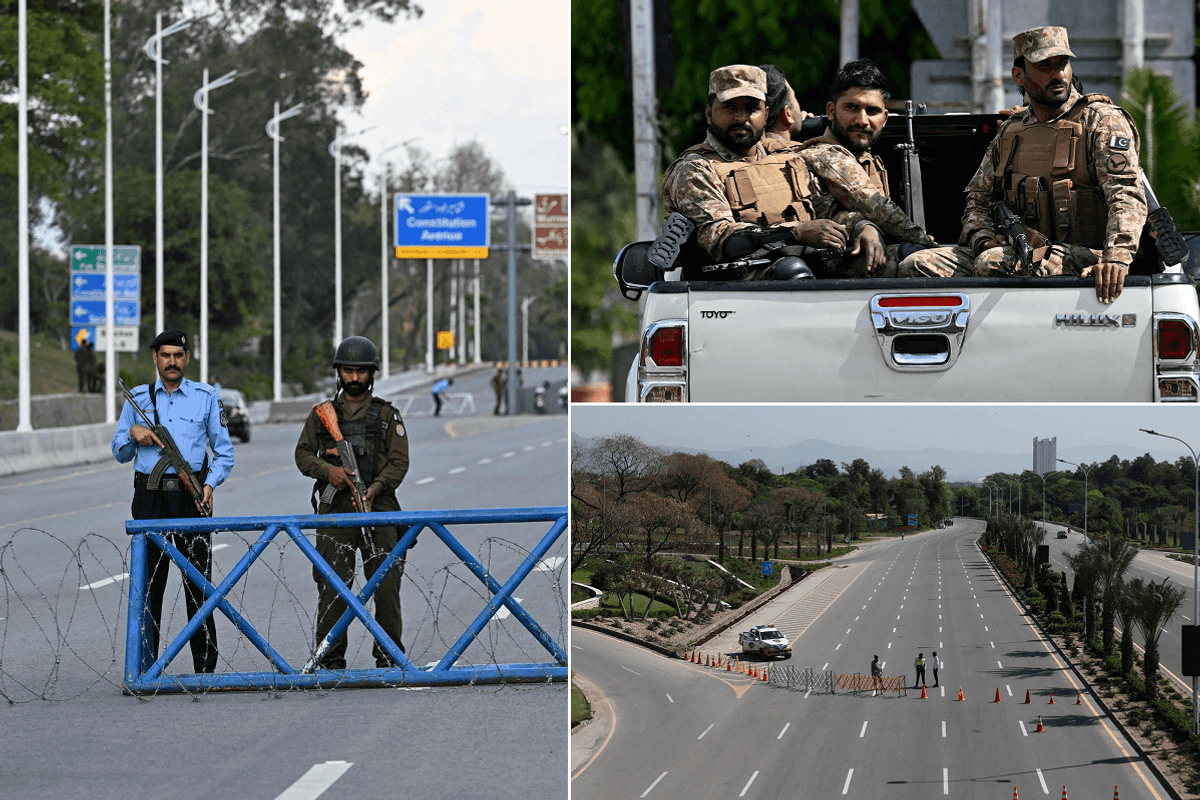
Security personnel stand guard as Islamabad tightens measures ahead of high-stakes US-Iran talks.
AFP/Agencies
Pakistan has tightened security and logistical arrangements in the capital as U.S.–Iran talks begin on Friday, with foreign delegations arriving in Islamabad for negotiations aimed at stabilizing a fragile ceasefire between the two sides.
Authorities have sealed off the capital’s heavily fortified Red Zone, restricting access to authorized personnel only, while a dedicated control room has been set up at the Ministry of Interior to monitor and coordinate security operations in real time.
The diplomatic engagement comes against the backdrop of heightened tensions that escalated into full-scale hostilities on February 28, following weeks of rising military pressure in the region, which ultimately led to a ceasefire brokered through Pakistan-led mediation after 40 days of fighting that claimed significant casualties. Officials say the current talks are intended to prevent the agreement from unravelling amid continued strains.
A high-level meeting chaired by Interior Minister Mohsin Naqvi today reviewed the security and logistical framework for the visit of foreign delegations. Naqvi directed authorities to ensure “foolproof” arrangements, describing Pakistan’s hosting of the talks as a diplomatic responsibility in a sensitive regional environment.
Pakistan has positioned itself as a facilitator of the process, with the Prime Minister’s Office saying Prime Minister Shehbaz Sharif and Chief of Army Staff Field Marshal Asim Munir Thursday reviewed mediation efforts and expressed support for maintaining the ceasefire.
An official statement said both leaders stressed the need for restraint by all parties and welcomed progress toward de-escalation.
To facilitate participation, Pakistan has suspended visa requirements for delegates and journalists attending the talks, introducing visa-on-arrival arrangements. Foreign Minister Ishaq Dar said airlines had been instructed to allow boarding for accredited participants even without prior visas, with immigration authorities to issue visas upon arrival.
The U.S. delegation is expected to be led by Vice President JD Vance, accompanied by former presidential aides Steve Witkoff and Jared Kushner. Iran’s delegation is expected to be headed by parliamentary speaker Mohammad Baqer Qalibaf, along with Foreign Minister Abbas Araghchi and senior officials.
The United States is reportedly entering the talks with a 15-point proposal covering Iran’s nuclear program, constraints on ballistic missile development, maritime security including the Strait of Hormuz, and broader regional stability.
Iran is expected to present a 10-point counter-framework seeking guarantees against future military action, a phased reduction of U.S. military presence in the region, and new arrangements on maritime security and regional de-escalation mechanisms.
Despite diplomatic momentum, analysts acknowledge the ceasefire remains fragile, with both sides continuing to trade accusations of violations as efforts intensify to preserve the agreement.

Comments
See what people are discussing