

Pakistan airspace closure adds to Indian airlines’ financial strain
Kamran Khan says longer routes and fuel costs have deepened losses and eroded Indian carriers’ global market share

News Desk
The News Desk provides timely and factual coverage of national and international events, with an emphasis on accuracy and clarity.
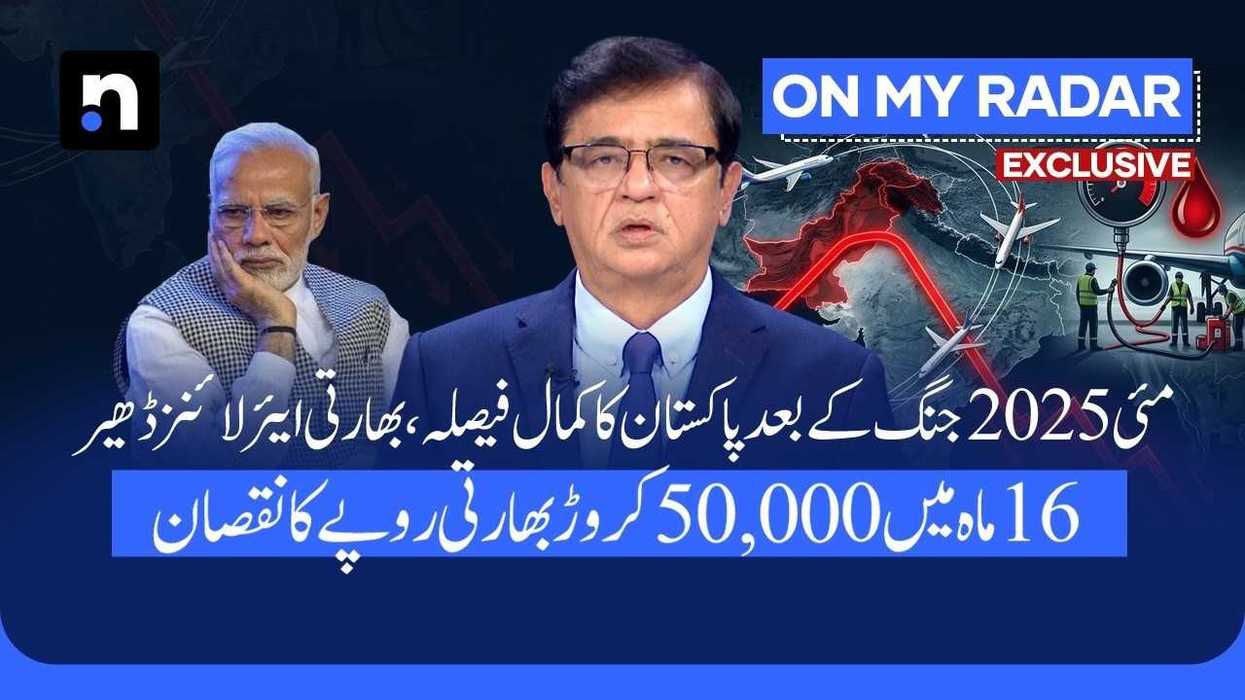
Pakistan’s 2025 decision to close its airspace to Indian airlines has imposed billions of dollars in additional costs on India’s aviation industry, according to data and industry estimates cited by Kamran Khan, with longer flight routes, higher fuel prices and falling international market share compounding the pressure.
In the latest episode of On My Radar, Khan said Pakistan’s airspace restrictions, imposed on April 24, 2025, had created a financial burden that continued into 2026. He cited an estimated 7,000 crore Indian rupees, or about $730 million, in losses to Indian airlines from the restrictions.
The closure came about two weeks before the May 2025 military conflict between India and Pakistan. Indian carriers that previously used Pakistani airspace for flights to Europe, North America and Central Asia were forced to take longer routes, increasing flight times, fuel consumption, crew hours and navigation costs.
The impact was not limited to individual flights. Longer journeys also reduced the amount of flying an aircraft could complete in a day, affecting airline productivity.
Air India warned the Indian government in April 2025 that if Pakistan’s airspace remained closed for a year, the airline could face additional costs of more than 5,000 crore rupees, or about $600 million. The airline sought government assistance to offset the impact.
The restrictions have remained in place through 2026, with Pakistan repeatedly extending the ban on Indian aircraft.
Higher fuel costs deepen the pressure
Khan said the financial pressure intensified in 2026 after the war involving the United States, Israel and Iran began on Feb. 28, disrupting regional aviation and energy markets.
Indian airlines were already flying longer routes because of the Pakistani airspace restrictions when jet fuel prices surged, he said.
According to Indian government figures, international aviation turbine fuel prices rose from 60.50 rupees per liter in March 2026 to 142 rupees in May, an increase of nearly 2.5 times. The government has said aviation turbine fuel normally accounts for about 40% of airline operating costs and can account for as much as 60% during periods of extreme price volatility.
Khan argued that the two pressures multiplied each other: Pakistan’s airspace closure increased fuel consumption, while the regional conflict sharply increased the cost of that fuel.
The impact was visible in the financial results of India’s major airlines.
Air India Group reported a loss of about $2.8 billion for the 2025-26 financial year, according to figures disclosed by shareholder Singapore Airlines. The company cited several pressures, including airspace disruptions, high fuel prices, supply-chain problems and restricted access to some Middle Eastern markets.
India’s largest airline, IndiGo, also moved from a profit to a loss in the quarter ended June 30, 2026. Its parent company, InterGlobe Aviation, reported a consolidated net loss of 238 crore Indian rupees, compared with a profit of 2,176 crore rupees in the same quarter a year earlier.
IndiGo’s aircraft fuel expenses rose 85.7% to 10,833 crore rupees and accounted for 44.1% of revenue, compared with 28.5% a year earlier.
Khan said smaller Indian carriers had also reduced international operations. By May, he said, Air India Express, Akasa and SpiceJet had made significant cuts to international departures, with some smaller carriers reducing international flights by about 60%.
Foreign airlines gain international market share
The financial pressure has coincided with a decline in the share of international passengers carried by Indian airlines.
Indian carriers carried about 7.3 million passengers on outbound international routes during the first six months of 2026, compared with about 9.06 million during the same period a year earlier, according to figures cited by Khan.
Their share of India’s outbound international passenger market fell from 46% to 39.7%, while foreign airlines increased their share to 60.3%. Recent Directorate General of Civil Aviation data reported by Indian media also showed Indian carriers’ international market share falling to 39.7% in January-June 2026 from 46% a year earlier.
Khan described the shift as more than an aviation statistic, arguing that Indian carriers were losing international business to foreign competitors.
When Indian airlines must fly longer routes and burn more fuel while foreign carriers can offer comparatively more efficient routes, he said, competing for international passengers becomes more difficult.
Industry loss forecasts rise sharply
Khan also highlighted a sharp change in the outlook for India’s airline industry.
Before the February 2026 conflict, rating agency ICRA had expected Indian airlines to post a combined net loss of about 11,000 crore to 12,000 crore rupees in the 2026-27 financial year. By June, ICRA had revised its estimate to 36,000 crore to 38,000 crore rupees, citing the West Asia conflict, higher aviation turbine fuel prices, a weaker rupee and higher aircraft lease costs.
ICRA also said fuel typically accounts for 30% to 40% of airline operating expenses, while the combined exposure to fuel, aircraft leases and maintenance leaves airlines vulnerable to movements in the dollar and fuel prices.
Khan said the revised forecast represented nearly three times the earlier expected loss and placed the industry under severe financial pressure. He estimated that when direct and indirect losses, including reduced tax revenues, are combined, the total cost to the Indian government and aviation industry could reach about 50,000 crore rupees, or $5 billion.
Those broader estimates are not equivalent to independently verified losses directly caused by Pakistan’s airspace closure. The industry’s financial deterioration has also been linked to fuel prices, regional conflict, currency movements, aircraft supply-chain problems and other operating costs.
Khan said the aviation industry was now facing a combination of longer routes, higher fuel costs, shrinking international operations, lost market share and sharply higher loss forecasts.
He attributed a significant part of the pressure to Pakistan’s April 2025 decision to close its airspace to Indian aircraft, arguing that the financial consequences had continued long after the military confrontation of May 2025.
“The second battle” that followed the military conflict, Khan said, was now being fought by Indian airlines on their balance sheets.



Comments
See what people are discussing