

Pakistan equities tumble in March as crisis fears grip investors
Oil price spike and geopolitical risks dragged index into steep decline

Haris Zamir
Business Editor
Experience of almost 33 years where started the journey of financial journalism from Business Recorder in 1992. From 2006 onwards attached with Television Media worked at Sun Tv, Dawn Tv, Geo Tv and Dunya Tv. During the period also worked as a stringer for Bloomberg for seven years and Dow Jones for five years. Also wrote articles for several highly acclaimed periodicals like the Newsline, Pakistan Gulf Economist and Money Matters (The News publications)
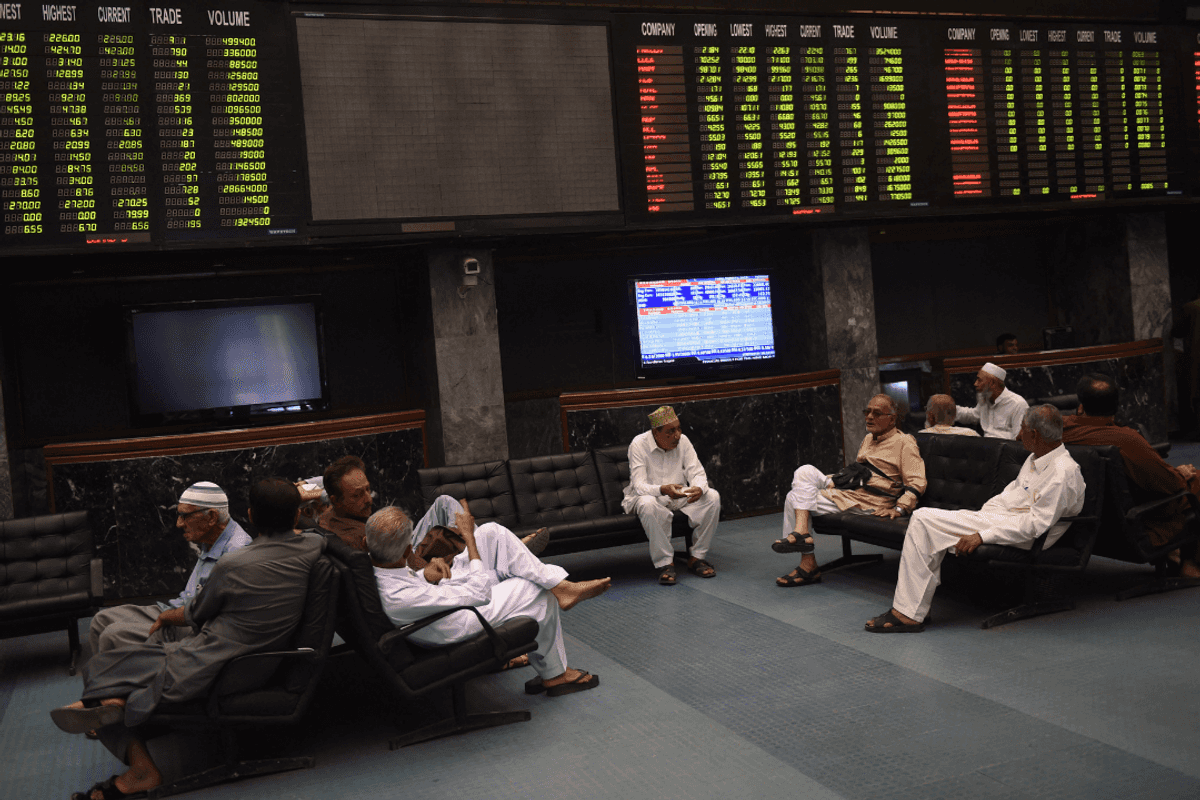
Pakistan equities endured a sharp selloff in March, as intensifying geopolitical tensions, surging global oil prices and mounting macroeconomic risks eroded investor confidence and dragged down market activity, brokerage reports said.
The benchmark KSE-100 Index declined 11.5% month-on-month (MoM), losing 19,319 points to close at 148,743. The index touched a high of 161,477 and a low of 144,119 during the month, extending its cumulative two-month correction to nearly 20%.
Market capitalization fell 13% MoM to PKR 16.5 trillion, while average daily traded value dropped 32% MoM to around $130 million (ready plus futures).
Volumes also contracted significantly, with average daily traded shares declining 37% MoM to 481 million compared to 766 million in February.
Geopolitical tensions shake global and local markets
According to Intermarket Securities, geopolitical developments remained the primary driver of market direction, as escalating conflict involving the United States, Israel and Iran disrupted global energy supply chains.
The closure of the Strait of Hormuz — a key global oil transit route — significantly constrained hydrocarbon supply, while reported damage to infrastructure across the Gulf Cooperation Council (GCC) region exacerbated the situation. Iran’s attack on Qatar’s LNG facilities further strained global energy markets.
As a result, benchmark crude prices surged, with Arab Light and Oman/Dubai crude averaging around $108 and $107 per barrel, respectively, and peaking near $135 during the month. Other commodities also saw sharp movements, with WTI crude rising 58% and coal prices increasing 13%, although gold prices declined 14%.
Spectrum Securities noted that persistent geopolitical tensions, volatile commodity prices and domestic security concerns “hammered” the market, significantly weakening investor sentiment.
Inflation, fuel policy and fiscal concerns
Rising oil prices translated into higher domestic fuel costs, with petrol and high-speed diesel (HSD) prices increased by PKR 55 per liter early in the month. However, the government opted to delay full pass-through of subsequent increases, resulting in elevated price differentials and an implied subsidy burden of approximately PKR 125 billion.
Analysts warn that this approach could widen fiscal deficits and exacerbate circular debt, particularly if it undermines commitments tied to the International Monetary Fund program.
Inflationary pressures have already begun to build, with headline CPI rising to 7.0% year-on-year in February, up from 5.8% in January, the highest reading since October 2024. Expectations of further increases in inflation have fueled concerns of tighter monetary policy ahead, despite the central bank maintaining its policy rate at 10.5% in March.
External account and IMF developments
On the external front, Pakistan recorded a current account surplus of $427 million in February, the highest since March 2025, compared to a deficit of $85 million in the same period last year. However, on a cumulative basis, the current account posted a deficit of $700 million during the first eight months of FY26, reversing a surplus of $479 million recorded a year earlier.
Pakistan also reached a staff-level agreement with the IMF under the Extended Fund Facility (EFF) and Resilience and Sustainability Facility (RSF), potentially unlocking about $1.21 billion, subject to board approval.
The IMF acknowledged progress on fiscal discipline and reforms but flagged risks stemming from geopolitical tensions and energy price volatility.
Investor activity and sectoral flows
Foreign investors remained net sellers during March, with net outflows ranging between $53 million and $72 million, largely driven by foreign corporates. Selling was concentrated in banking (around $30.5 million) and cement ($30.2 million) sectors, with additional outflows in fertilizer and power.
Conversely, some inflows were recorded in food, technology and exploration and production (E&P) sectors.
Local investors provided partial support to the market. Individuals and banks emerged as key buyers, contributing net inflows of approximately $48 million and $46 million, respectively, alongside smaller contributions from insurance and other participants. However, mutual funds and brokers remained net sellers.
Arif Habib Limited highlighted that subdued sentiment, persistent selling pressure and seasonal slowdown during Ramadan further dampened trading activity.
Outlook: cautious but selective stance
Looking ahead, analysts expect market direction to remain highly sensitive to global oil price trends, geopolitical developments and incoming macroeconomic data, particularly inflation readings and IMF program details.
While the recent correction has improved valuations — with the KSE-100 trading at a forward price-to-earnings ratio of around 7.0x, below its long-term average of over 8.0x — uncertainty surrounding the duration of geopolitical tensions is likely to keep investors cautious.
That said, Intermarket Securities noted that historical valuation bands suggest limited downside from current levels, particularly in periods of elevated interest rates and weak external buffers.
Brokerages maintain a cautious but selective investment approach, favoring companies with resilient balance sheets, foreign currency-linked earnings and strong dividend yields as Pakistan’s equity market navigates a volatile macroeconomic and geopolitical landscape.




Comments
See what people are discussing