

Pakistan football’s long road back
From FIFA suspensions and years of inactivity to a historic final appearance, Pakistan football is finally finding its footing again

Assaam Sany
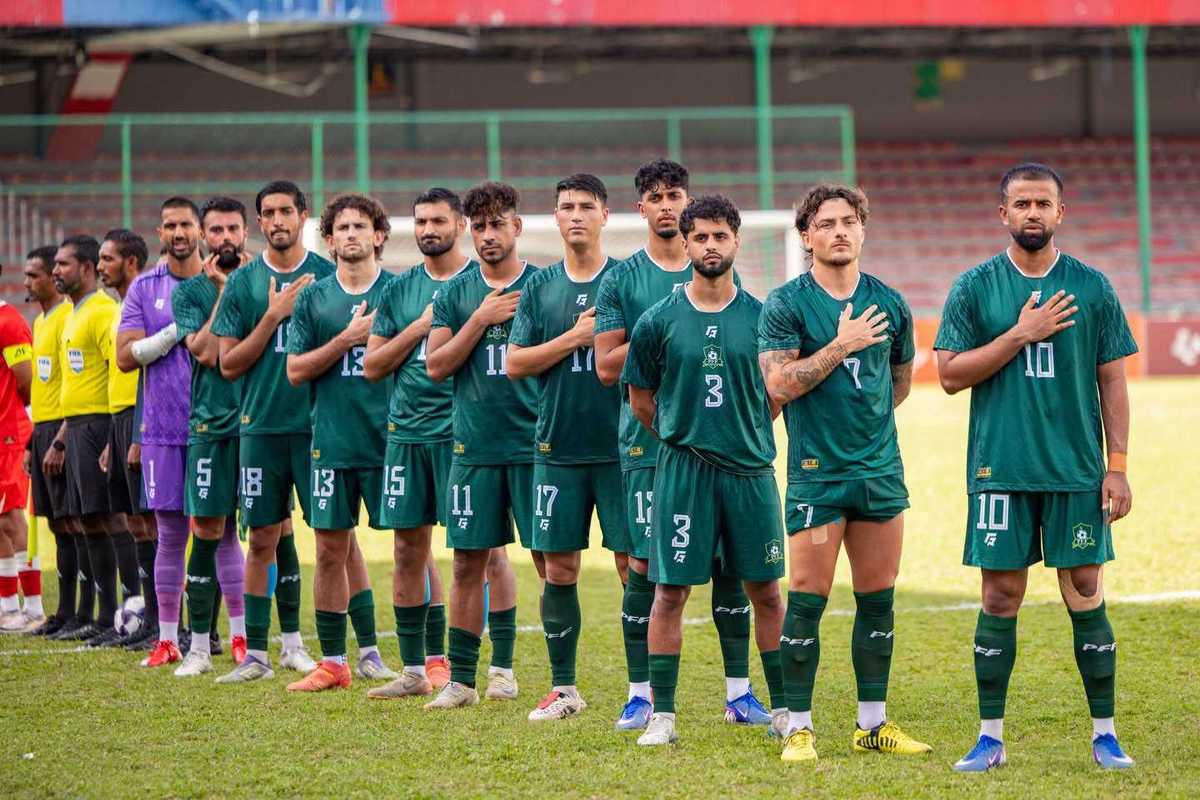
Pakistan football team stands for the national anthem before the match against Afghanistan in Maldives.
PFF
Not long ago, the story of Pakistan football was one of suspension letters, missed tournaments, and empty stadiums. A country of more than 250 million people, one of the most populous on earth yet one of the lowest ranked in FIFA, largely invisible on the global football map.
The Pakistan Football Federation had been suspended by FIFA three separate times since 2017, most recently in February 2025 over governance failures, before the ban was lifted the following month.
Football in Pakistan fights to make a space for itself every day, not just because of the administrative and governance issues in the past but also because of the fact that Pakistan has always leaned on sports like cricket, hockey and squash. For football, being in that shadow has been suffocating.
Yet, something has been quietly shifting ever since that fateful day in Islamabad in October, 2023. A 1-0 win over Cambodia in the FIFA World Cup Qualifiers lifted Pakistan four places in the FIFA rankings, a small number that carried enormous symbolic weight. Behind that scoreline is a story of a gradual and unglamorous rebuilding.
A brutal lesson in reality
The Cambodia win did not open a door so much as crack a window. What followed was a harsh, necessary education. Pakistan was drawn into Group G of the second round of FIFA World Cup 2026 Qualifiers, alongside Saudi Arabia, Jordan, and Tajikistan, a group that exposed precisely how thin the margin between a historic result and the wider reality of Pakistani football still was. Pakistan lost all six of their qualifying matches. Thrashed by Tajikistan 6-1 at Jinnah Stadium. Conceded 7 goals away in Amman by Jordan. By the time the campaign was over, Pakistan sat bottom of the group, a brief moment of euphoria buried under a mountain of goals conceded.
Since the win against Cambodia, critics of Pakistan Football either forget or overlook the fact that Pakistan team was pitted against some of the best and biggest Asian giants in football in the second round. Saudi Arabia were under the guidance of Roberto Mancini at the time, while Tajikistan had already made headlines by reaching the quarter-finals of the 2023 AFC Asian Cup before being eliminated by Jordan — a side that went on to reach the final against Qatar and finish as runners-up.
The Shaheens went from almost no football activity in a decade to playing against some of the top teams in Asia which makes the victory against Cambodia look small in comparison. But the key element during this time was the fact that even with limited funding and governance issues, participation did not stop, even if it was minimal.
This might not seem like much progress to football fans in Pakistan who are more accustomed to following football on the global scale. Fans of Premier Legaue, La Liga, Bundesliga and more are used to watching a more high-quality football which, in part, allowed analysts and critics quick to point out the mistakes in strategy, formations and tactics.
The diaspora effect
What truly accelerated this resurgence, however, was the increased reliance on overseas Pakistani talent. While diaspora call-ups were not new — dating back to 2005 when former Fulham defender Zesh Rehman made his debut — the approach was significantly ramped up in 2022 under coach Shahzad Anwar. He brought in Harun Hamid from Queens Park Rangers, Abdullah Iqbal from Danish club B93, and Abdul Samad Arshad from HB Køge, alongside fresh call-ups for Easah Suliman and Otis Khan from Grimsby Town. The squad also included Rahis Nabi, a former Burnley youth player.
But to tell only the diaspora side of Anwar's story is to miss half of it. When Pakistan returned to international football after their long hiatus, Anwar oversaw a near-total generational change, only four players in that first returning squad had any prior senior international experience. The rest were young, largely unknown and inexperienced. Players like Rao Umar Hayat, a right-back or Mamoon Moosa Khan, a centre-back who came through POPO FC before joining Pakistan Air Force, or Alamgir Ghazi, a midfielder who started playing football at the age of eleven in Chitral, coming through Highlanders FC before earning his place in departmental football and eventually the national squad.
These are not glamour stories. They are stories of players who had no professional league to develop in, no academies with video analysis and sports science, no guarantee of even being paid on time and yet they kept playing anyway. By 2026, several of these same local players, Umar Hayat, Ghazi, Shayak Dost, Abdullah Shah and more had earned professional contracts at clubs abroad.
While Shahzad Anwar’s tenure was criticized based on results, the losses, the conceded goals, the tournament exits. What was less often acknowledged was that Anwar had walked into near-nothing and walked out having assembled the core of a team that would go on to make history.
Teaching Pakistan to believe
Stephen Constantine took the helm of the team from Shahzad Anwar and used the same group alongside local players to win the match against Cambodia. If Shahzad Anwar laid the foundation, Stephen Constantine arrived to build on it with an urgency bordering on the theatrical. He was appointed in September 2023 with Pakistan's first-leg against Cambodia already scheduled, giving him roughly two weeks to prepare a team for the most important match in their recent history. Most coaches would have used that as an excuse. Constantine used it as a challenge.
Constantine's response was exactly what the moment demanded: discipline, organization, and a refusal to be beaten easily. He was blunt, unwavering and unforgiving about his philosophy. His words might have seemed hollow at the moment with Pakistan team’s recent performances but then Cambodia came to Islamabad and couldn't score. Constantine later called it one of the best moments of his career, not necessarily for the performance, but for the impact it had across the country. Personally, being on the pitch that day, I had never seen so many grown men cry, including myself. Even with the defeats that followed, Constantine had taken a team that had spent years apologizing for existing on a football pitch and taught it, however briefly, to believe it belonged there.
Then came Nolberto Solano, a former Premier League star. A Newcastle United legend walking into one of world football's most complicated jobs was, on paper, a curious choice. But Solano came in with conviction. While tapping deeper into the diaspora pipeline his predecessors had started. His squad for the ongoing Diamond Jubilee Tournament in Maldives reflected that vision, a careful blend of domestic players and overseas-based talent, players who had come through the same system Anwar had begun assembling and Constantine had refined.
Proof of progress
The results in Malé have been the most tangible proof yet that the system is working. Not just the 3-0 win over Maldives, significant as it was, but the manner of the whole campaign.
The start against Bangladesh was not the most perfect but avoiding a loss gave the team a confidence that reflected in the next two games. However, a dominant win over the hosts kept Pakistan in contention. Then, against Afghanistan, a 2-0 victory that put Pakistan into a tournament final for the first time since the 1962 Merdeka Cup, 64 years of waiting, ended with goals from Umar Nawaz and Harun Hamid. The same Harun Hamid, it is worth noting, who scored the winner against Cambodia.
These might seem small steps for a nation so big it should have football talent easily available all over the country but in context of history of Pakistan Football, these are significant milestones that can kickstart a resurrection long overdue in a country that follows and plays football with perhaps as much enthusiasm as cricket.
Pakistan have faced some of the biggest and strongest teams in Asia in a short span of time, and expecting them to beat continental giants after decades of inactivity is not only unrealistic but also unfair.
Yet those defeats, no matter how heavy, did not take away one thing: resilience. Regardless of the challenges off the pitch, this team's ability to keep showing up, time and again, is a reminder that a lost cause is never truly lost as long as someone is still willing to fight for it.
This side has also shown that it can compete when matched against teams closer to its own level. And a Pakistan team that knows it can compete is a very different proposition from one that has forgotten how to try.
Assaam Sany is a sports marketing and operations professional with more than 15 years of experience in the industry and currently serves as Director of Football Operations at the Pakistan Football Federation.





Comments
See what people are discussing