

Rationing or price hike – the dilemma ‘fueling’ Pakistan’s economic crisis
As global oil supplies remain disrupted, the government has two choices to manage the domestic fuel consumption

Abdul Moiz
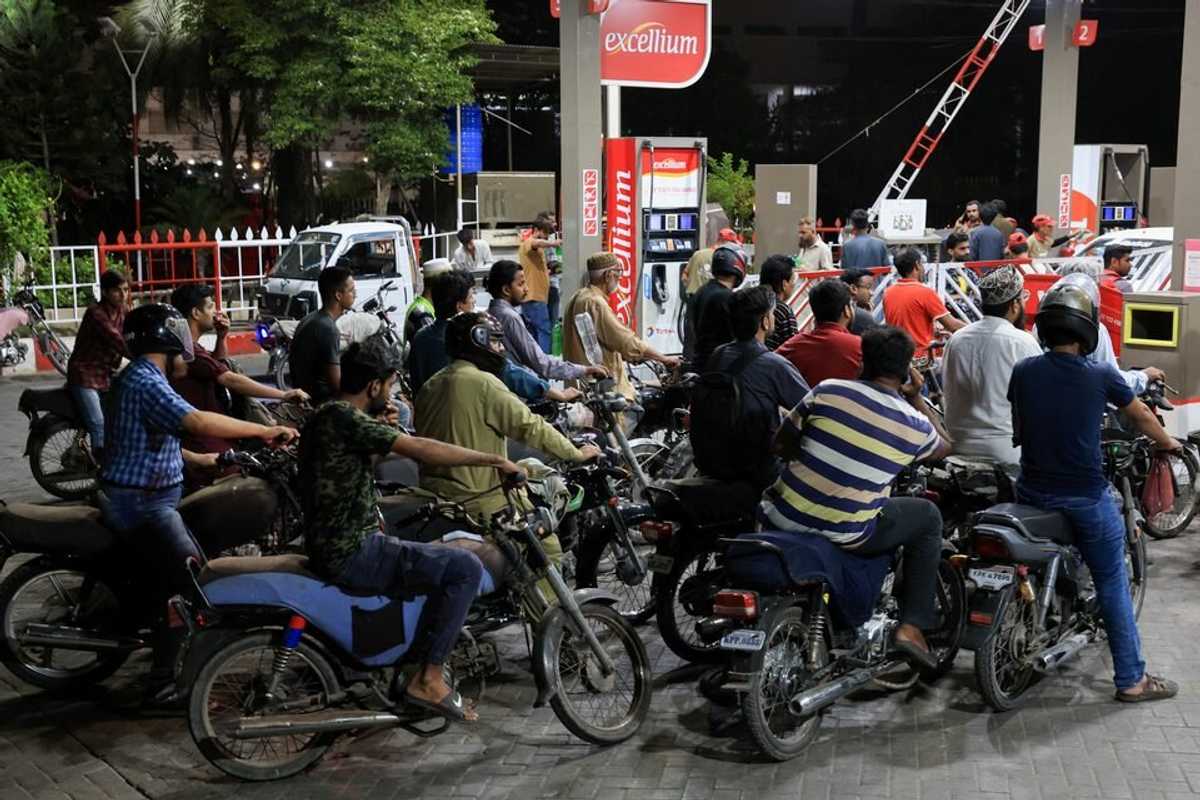
The US-Iran-Israel war has sent global energy prices into turmoil. The conflict has created a perfect conundrum for the Pakistan government, which finds itself between two choices, both of which carry significant economic implications.
As global oil prices surge to their highest level in years, and supply remains disrupted due to the closure of the Strait of Hormuz, the challenge has become two-fold: the first is that not enough oil is available to meet the demand, and the second is that the cost of available supply has multiplied due to higher shipping charges.
In this situation, the Pakistani government can take one of two decisions: either increase the prices of petroleum products or implement a rationing system to conserve the already scarce supplies.
The first choice
With weekly revisions, the government has to make another decision on fuel prices in five days. Will it pass on the full impact of global oil prices or keep them unchanged by compromising on its revenue?
In the days after the US-Israel strikes on Iran, the Pakistan government reacted proactively to manage fuel supplies. The prime minister formed a committee to oversee the available stock and to arrange the procurement of oil to meet local demand. Within a week of the strikes, the government increased the prices of petrol and diesel by PKR 55.
The decision was made to scuttle an artificial shortage due to the local and international price differentials.
A week later, on March 13, the government decided not to pass on higher global prices to consumers and kept the rate unchanged by cutting the Petroleum Development Levy.
The price of high-speed diesel in the international market has risen from $88 to $187 per barrel and petrol from $74 to $130 per barrel.
Analysts estimate that the average oil price of $100 per barrel would push Pakistan’s inflation to around 11% in the short term.
This move to increase the rate will compound citizens' miseries, as higher fuel prices lead to a rising cost of living. As inflation rises, the State Bank of Pakistan increases the interest rate to cool the economy. Higher interest rates slow economic growth because borrowing becomes costlier.
So what happens if the government chooses not to pass on the impact of rising global prices to consumers? The answer lies in the economic crisis, which unfolded around three years ago.
After the Russian invasion of Ukraine in 2022, global oil prices rose steeply. However, the government chose not to raise fuel prices. Petrol was held at PKR 150 per liter for months, even as import costs climbed. The result was a rapid deterioration in the current account balance, which forced the country into an IMF bailout.
Pakistan's current account deficit stood at $541 million in February 2022. By March, it had nearly doubled to $981 million. It briefly eased to $640 million in April, then accelerated sharply — hitting $1.51 billion in May and $2.32 billion in June. In four months, the monthly deficit had more than quadrupled.
Simply put, Pakistan was buying costly petroleum products and didn’t have enough forex reserves to pay for them. As a result, the country started running out of dollars fast and had to go to the IMF to stave off an economic meltdown.
This was due to higher import prices of petroleum products.
The government’s decision not to gradually pass on the impact of rising prices resulted in the accumulation of a differential, forcing massive price hikes in one go.
The price of petrol remained around PKR 150 per liter between February and May. However, in the following month of June, the price was increased by PKR 30 to around 180 per liter and then by a whopping PKR 70 to around PKR 250 per liter by July.
The second choice
It is apparent that whether the government decides to increase or decrease the prices, it will have massive consequences – one in the form of inflation, the other in the form of economic crisis.
One way to avoid – or mitigate – the two scenarios is to cut down consumption of petroleum products through rationing. This will result in a lower import bill, thus preserving dollars, and reduce the strain on the government’s revenues if it decides not to pass on the impact of higher global prices to consumers.
In February, Pakistan imported petroleum products worth $983 million. Of this amount, roughly $284 million was spent on petroleum products and $423 million on crude oil.
The import bill is expected to rise in March to reflect higher global prices. It will widen the current account deficit as the government will have to burn its dollar reserves to pay for imports.
In crises like these, governments turn to fuel rationing. Fuel rationing is an old tool, deployed in every major energy crisis from the Second World War to the oil shocks of the 1970s, to the economic crisis of the 21st century.
In the wake of the current crisis, a number of countries have intervened to conserve fuel and ease the burden on the supply chain.
Sri Lanka reactivated its National Fuel Authorization System, under which no fuel station in the country is permitted to dispense petrol or diesel to any vehicle without a valid QR code. The system was first deployed during the 2022 economic collapse to overcome a sharp rise in domestic fuel demand, driven in part by illegal hoarding.
Under the weekly quota announced alongside the system, buses receive 60 litres, motorcycles five litres, cars 15 litres, vans 40 litres, and motor lorries up to 200 litres.
Myanmar has announced a nationwide fuel rationing system under which private, commercial, and other transport vehicles must follow an odd-even license plate schedule.
Under the new scheme, even-numbered plates will only be allowed to drive on even dates, and odd-numbered plates on odd dates, the announcement said.
Bangladesh, which relies on imports for 95% of its energy needs, closed universities and launched fuel rationing. Meanwhile, severe gas shortages forced the country to halt operations at four of its five state-run fertilizer factories, redirecting available gas to power plants.
Under the Thai government policy, four-wheel vehicles can purchase no more than 700 baht of fuel per vehicle each day. Meanwhile, trucks can buy fuel worth up to 3,000 baht per person daily.
Rationing itself leads to several economic consequences that policymakers must account for, ranging from the emergence of black markets to enforcement challenges to compressed economic activity.
There are no guarantees – at least none at this moment – when the conflict in the Middle East will be over. However, even if the conflict ends tomorrow, it will take weeks for oil supplies to return to normal level.
In any case, Pakistan has to brace for a prolonged disruption in fuel supplies. The government will have to make a choice between a price hike and rationing to avert a full-blown economic catastrophe.


Comments
See what people are discussing