

Planning minister hails Pakistan’s 3.8% growth rate despite global challenges
Says US-Israel war on Iran poses significant risks for Pakistan’s economy through higher global oil prices, increased import bills, and inflation

Business Desk
The Business Desk tracks economic trends, market movements, and business developments, offering analysis of both local and global financial news.
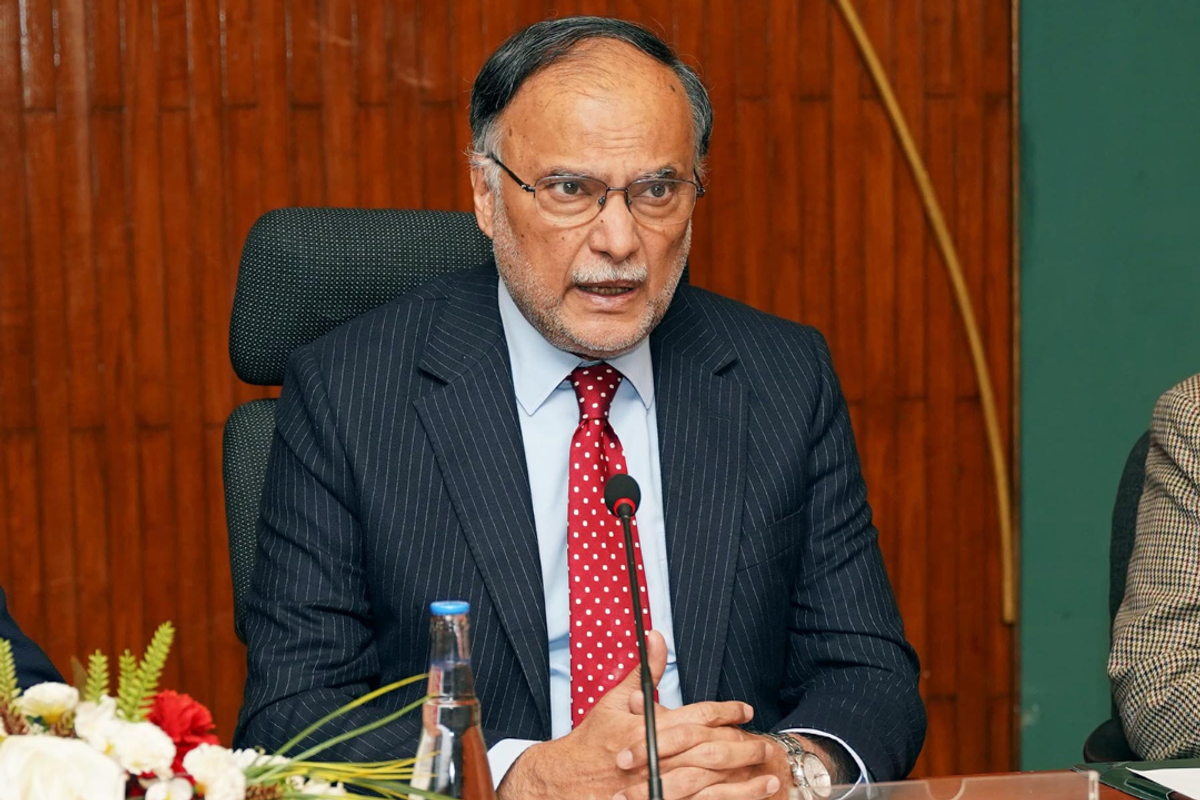
Pakistan Minister for Planning, Development and Special Initiatives Ahsan Iqbal
Pakistan’s Federal Minister for Planning, Ahsan Iqbal, has said the economy demonstrated notable stabilization during the first eight months (July-March) of the current fiscal year with growth rising to 3.8% compared to 1.9% last year.
He made these remarks in a virtual news conference at the launch of the ministry’s Monthly Development Report on Monday.
The minister noted that inflation has declined to 5.5%, while economic activity has also improved significantly. He said this improvement reflects better performance in both external and fiscal sectors, supported by ongoing reforms and prudent economic management.
Referring to global developments, Iqbal said the conflict in the Middle East has emerged as a major external shock for the world economy, affecting growth and inflationary trends.
He stated that the International Monetary Fund has revised global growth projections downward to 3.1% for 2026, compared to the pre-war estimate of 3.3%, while global headline inflation is expected to rise to 4.4% from 3.%.
He added that the conflict poses significant risks for Pakistan’s economy through higher global oil prices, increased import bills, inflationary pressures, and vulnerabilities in the external sector, including exports and remittances.
The minister highlighted that Pakistan has also faced domestic inflationary pressures, with average inflation rising to 5.7% during July–March FY2026 compared to 5.3% last year. Monthly inflation in March increased sharply to 7.3% from 0.7% in the same month last year.
He explained that this increase is primarily driven by non-food components, especially energy costs linked to global oil price shocks and tariff adjustments, while food inflation has remained relatively contained, requiring continued monitoring and targeted policy interventions.
Iqbal emphasized that the government has adopted a balanced and proactive approach to managing energy price volatility. He said the government took difficult decisions, including an increase of PKR 55 per liter in petrol and diesel prices while absorbing a fiscal burden of PKR 129 billion to shield citizens from the full pass-through of global oil prices.
On development and economic indicators, Iqbal stated that large-scale manufacturing recorded a strong recovery of 5.9% growth during July–February FY2026.
He further noted that FBR revenues reached PKR 9.3 trillion during July–March FY2025, reflecting a 10.1% increase, supported by improved enforcement and administrative reforms.
He said remittances remained strong at $30.3 billion, growing by 8.2%, while exports of goods and services reached $30.6 billion during July–March FY2026.
Services exports grew significantly by 17% to $7.3 billion, resulting in a 7% reduction in the services deficit. The current account also showed resilience, posting a surplus of $1.07 billion in March, although the cumulative surplus for July–March stood at $8 million compared to $1.67 billion last year.
On fiscal and development performance, the minister stated that PSDP utilization reached 42% (PKR 415 billion), higher than last year’s 36.4%, reflecting increased development activity.


Comments
See what people are discussing