

Pakistan’s mediation efforts gain momentum as US-Iran talks near breakthrough
Kamran Khan says Pakistan is playing a central role as hopes grow for a US-Iran agreement

News Desk
The News Desk provides timely and factual coverage of national and international events, with an emphasis on accuracy and clarity.
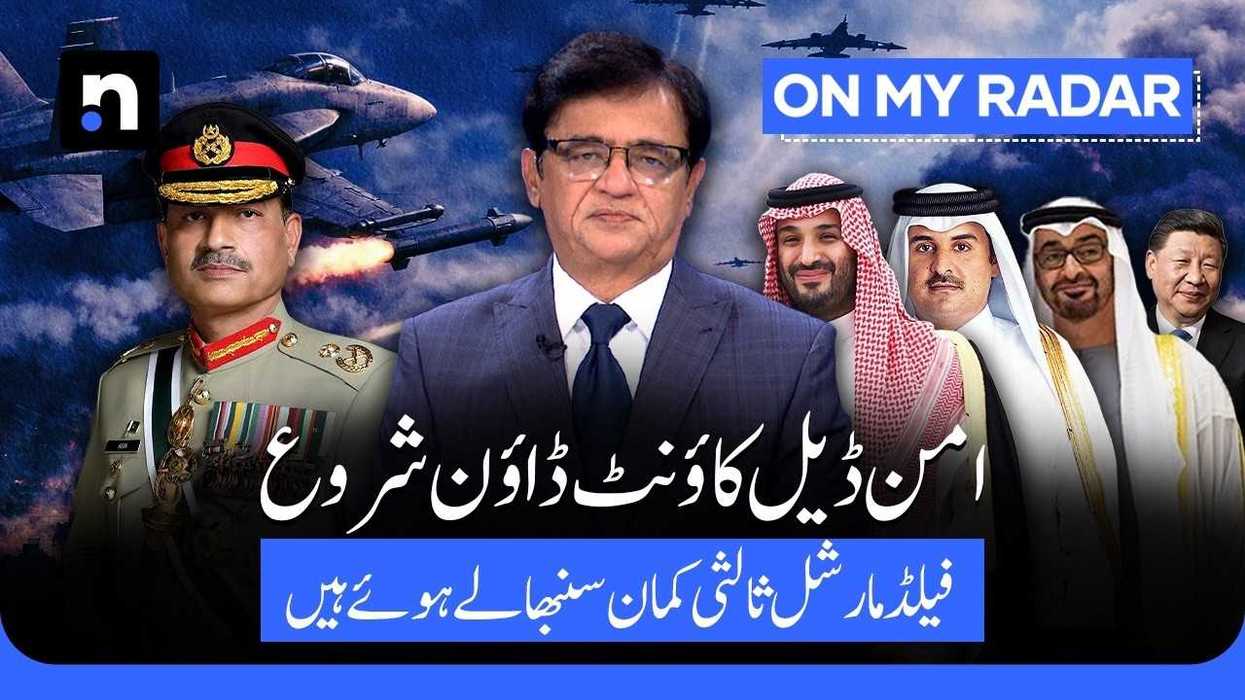
Pakistan has emerged as a key diplomatic intermediary in efforts to end the conflict between the United States and Iran, with signs growing that both sides could soon move toward a partial agreement, according to comments made by Kamran Khan during his program “On My Radar.”
Kamran Khan said informed sources in Tehran, Washington and Islamabad believe a major development could emerge within the next 24 hours regarding efforts to end the war.
The comments came as Pakistan’s army chief, Field Marshal Asim Munir, arrived in Tehran alongside Pakistan’s national security adviser and ISI chief Lt. Gen. Asim Malik.
Observers are viewing the visit as a possible indication that negotiations between Washington and Tehran may be entering a decisive stage, Kamran Khan said.
According to the program, reports had circulated since Thursday that talks aimed at ending the conflict were in their final stages and that Munir’s visit to Iran was dependent on receiving what Khan described as a diplomatic “green signal.”
The developments have strengthened perceptions in diplomatic circles that the United States and Iran may be moving closer to a limited or partial agreement.
Khan said U.S. Secretary of State Marco Rubio praised Pakistan’s role in mediation efforts and described Islamabad as an important interlocutor between Washington and Tehran.
Rubio was quoted as saying he remained in regular contact with Munir and expressed hope that an agreement with Iran could be reached soon.
Khan also recalled that Munir visited Iran for three days in April. During that trip, Iranian Foreign Minister Abbas Araghchi announced through a social media post that restrictions linked to the Strait of Hormuz had been lifted.
Another significant development, according to the program, involves regional back-channel diplomacy and mediation efforts by Gulf countries.
Khan cited a Reuters report stating that, with U.S. consultation, a Qatari negotiating delegation arrived in Tehran on Friday to help advance a possible agreement aimed at ending the conflict.
Pakistan’s Interior Minister Mohsin Naqvi has also remained in Tehran for the past three days and is actively involved in mediation efforts between the two sides, Khan said.
According to the program, Naqvi has spent six days in Tehran within a single week and has held repeated meetings with Iranian President Masoud Pezeshkian and Araghchi to discuss differences between Tehran and Washington as well as possible new proposals.
Khan cited Al Jazeera reporting that Pakistani officials are engaged in “intense mediation activity” aimed at paving the way for an acceptable agreement.
A senior Iranian official reportedly said a deal appears close, although another Iranian source cautioned it was still premature to say a final agreement had been reached.
Khan said U.S. President Donald Trump had also hinted at progress by stating that mediating countries were working on a “letter of intent” that could eventually be signed by both Washington and Tehran to formally end the conflict.
According to Khan, Al Arabiya reported that a draft agreement between the United States and Iran had already been prepared and could become public within hours.
The reported agreement includes an immediate, complete and unconditional ceasefire across all fronts. Both countries would also pledge not to target each other’s military, civilian or economic infrastructure.
Khan said the draft also reportedly guarantees freedom of navigation in the Strait of Hormuz and outlines the phased lifting of U.S. sanctions on Iran if both sides comply with the agreement’s terms.
The report added that further negotiations on unresolved issues could begin within seven days and after the completion of the Hajj pilgrimage.
Despite the optimism, major disagreements remain.
Khan said Pakistani sources quoted by Al Arabiya warned that bridging differences between Washington and Tehran would not be easy because both sides continue to hold extensive demands.
The biggest sticking point, according to the report, remains Iran’s enriched uranium stockpile.
Trump has publicly stated that the United States wants to take control of Iran’s enriched uranium and potentially destroy it as part of any nuclear arrangement.
However, Khan said Iranian Supreme Leader Mojtaba Khamenei has instructed that the uranium must not be transferred outside the country under any circumstances.
The conflict has also triggered concerns in global energy markets.
Khan said the International Energy Agency warned the Iran crisis could create the world’s “worst energy shock” if Middle Eastern oil supplies are not restored soon, potentially pushing global energy markets into crisis during the peak summer months.
At the same time, opposition to the conflict appears to be rising within the United States.
Citing a new Fox News poll, Khan said 60% of Americans now oppose the Iran war, up from 55% last month. The survey also found that 91% of respondents believe the conflict is contributing to economic turmoil.
Whether Pakistan’s mediation can ultimately produce a breakthrough remains uncertain, Khan said, but success could significantly enhance Islamabad’s diplomatic standing while helping avert a wider regional crisis.

Comments
See what people are discussing