

Pakistan central bank keeps interest rate unchanged at 10.5%
The decision was taken amid conflict in the Middle East which has skyrocketed oil prices
Haris Zamir
Business Editor
Experience of almost 33 years where started the journey of financial journalism from Business Recorder in 1992. From 2006 onwards attached with Television Media worked at Sun Tv, Dawn Tv, Geo Tv and Dunya Tv. During the period also worked as a stringer for Bloomberg for seven years and Dow Jones for five years. Also wrote articles for several highly acclaimed periodicals like the Newsline, Pakistan Gulf Economist and Money Matters (The News publications)
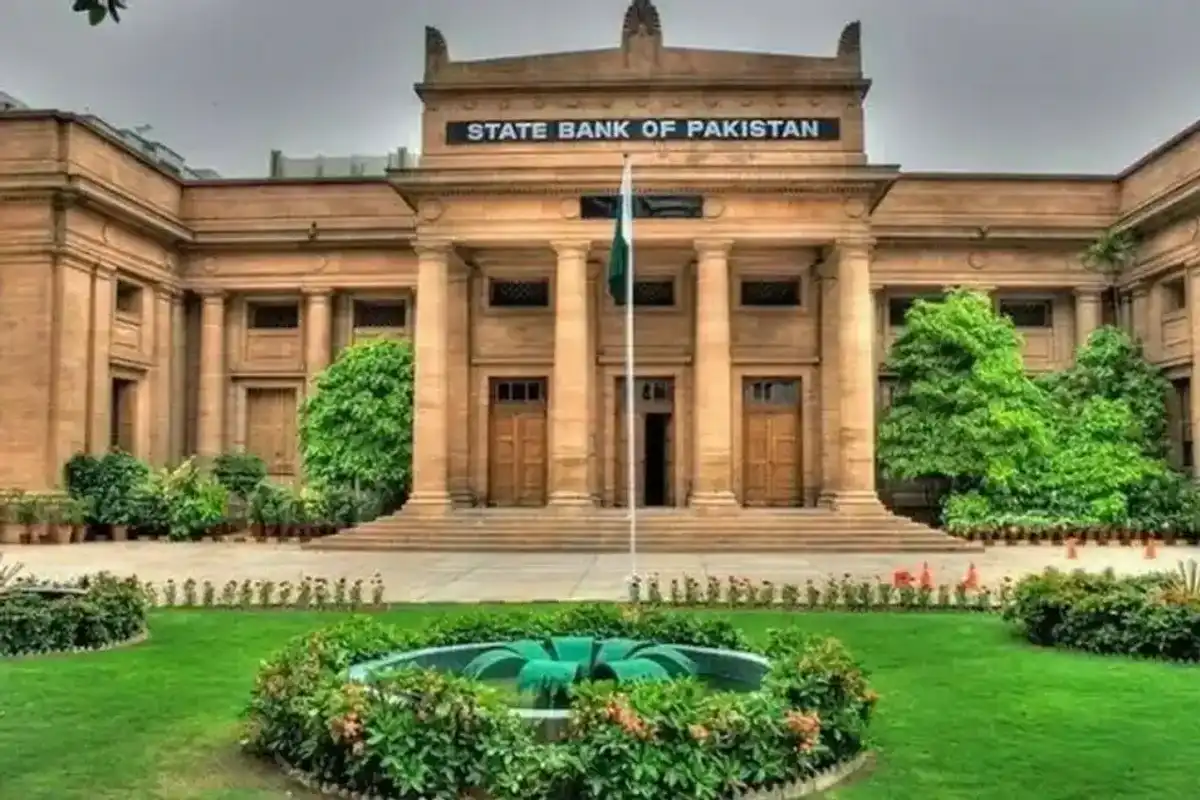
State Bank of Pakistan building in Karachi
SBP
The State Bank of Pakistan (SBP) has kept the interest rate unchanged at 10.5% to curb inflation following the escalation of war in the Middle East, which led to a surge in crude oil prices to an almost six-year high.
The decision was announced after a meeting of the State Bank of Pakistan’s Monetary Policy Committee (MPC) on Monday.
A statement issued after the meeting said recent economic data broadly matched projections released after the MPC's January meeting but warned that geopolitical tensions have made the economic outlook more uncertain.
The committee said the conflict in the Middle East has driven a sharp increase in global fuel prices as well as freight and insurance costs, while also disrupting cross-border trade and travel. Officials said the scale and duration of the conflict will determine how strongly it affects Pakistan’s economy.
Despite the risks, the central bank said Pakistan’s macroeconomic fundamentals — including inflation trends and foreign exchange and fiscal buffers — are stronger than they were at the start of the Russia-Ukraine war in early 2022. Its preliminary assessment suggests that key economic indicators for fiscal year 2026 remain within previously projected ranges, though risks have increased significantly.
Inflation has recently accelerated, rising to 5.8% in January and 7% in February 2026. Meanwhile, the country’s current account posted a surplus of $121 million in January, keeping the cumulative deficit for July through January at $1.1 billion.
The central bank said the surplus, combined with weak official inflows, enabled it to continue purchasing foreign currency from the interbank market, pushing foreign exchange reserves to $16.3 billion as of Feb. 27.
Economic activity has shown signs of gradual improvement. Large-scale manufacturing grew 0.4% year-on-year in December, with cumulative growth reaching 4.8% during the first half of fiscal year 2026. High-frequency indicators such as auto sales, cement dispatches, electricity generation and petroleum sales also recorded higher growth during July-January.
Based on these developments, the MPC said it expects real GDP growth to remain within its earlier projected range of 3.75% to 4.75% in fiscal year 2026, although geopolitical tensions pose downside risks.
The committee also highlighted continued fiscal consolidation but noted that tax collection remains below target. Federal Board of Revenue collections rose 10.6% during July-February, slower than required to meet the government’s annual goal.
Meanwhile, private sector credit expanded by 790 billion rupees through Feb. 20, reflecting increased lending for working capital and fixed investment, particularly in textiles, wholesale and retail trade, and chemicals.
Looking ahead, policymakers warned that uncertainty around global commodity prices and supply chain disruptions could put pressure on inflation. Headline inflation reached 7% year-on-year in February, partly due to the fading of earlier low base effects and adjustments in electricity charges for households.
Core inflation also rose to about 7.6%.
The central bank said the impact of higher domestic energy prices may be partly offset by easing food prices and improved agricultural supply conditions.
Even so, the MPC expects inflation to remain above 7% for the remainder of fiscal year 2026 and into fiscal year 2027.
“The committee reaffirmed its commitment to maintaining the hard-earned price stability,” the statement said, while stressing the need for structural reforms to ensure sustainable economic growth.





Comments
See what people are discussing