


News Desk
The News Desk provides timely and factual coverage of national and international events, with an emphasis on accuracy and clarity.
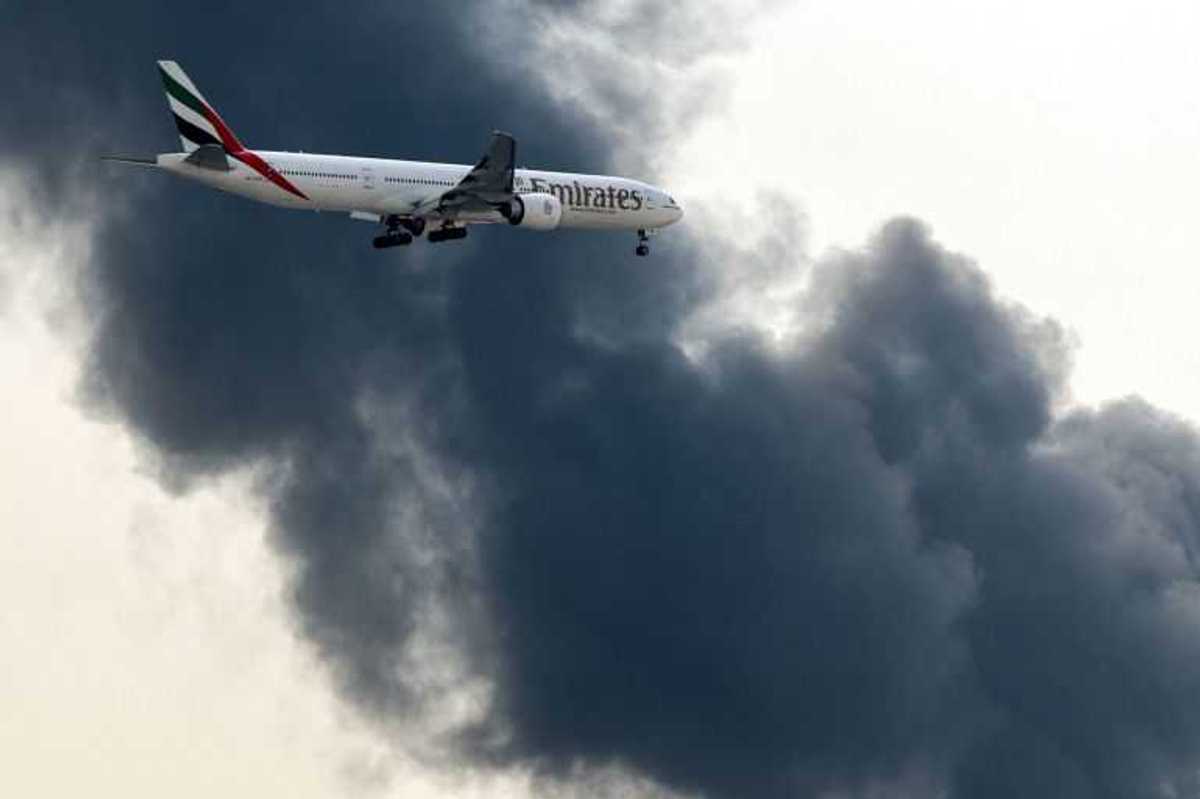
An Emirates Boeing 777 aircraft prepares for landing as a smoke plume rises from a fire at Dubai international airport in Dubai on March 16, 2026.
AFP/File
The United Arab Emirates restricted flights to a handful of approved routes until at least May 11 and activated emergency security protocols, according to Notices to Air Men (NOTAMs) published by its General Civil Aviation Authority.
The move came after the UAE said its air defenses were thwarting Iranian missiles and drones on Monday, forcing multiple flights to divert to Oman's Muscat and circle over Saudi Arabia.
The restrictions came two days after the UAE had lifted all precautionary airspace measures.
Why did the UAE restrict its airspace?
The UAE restricted its airspace after Iran fired missiles and drones at the country, the first such strikes since a ceasefire was declared nearly a month ago.
Air defenses intercepted several projectiles, but the attacks forced flight diversions and prompted emergency security protocols.
The NOTAMs stated "EMIRATES FIR PARTIALLY CLOSED," limiting flights to specific entry and exit points.
The UAE's foreign ministry condemned the strikes as a "dangerous escalation and an unacceptable transgression."
A strike on an energy installation in the emirate of Fujairah injured three Indian nationals. Two more people were injured when a residential building was hit in Oman's Bukha, along the Hormuz coastline.
According to the UAE defense ministry, Iran fired four cruise missiles, three of which were shot down and one of which fell into the water. Iran also fired drones at a tanker affiliated with its state-owned oil giant ADNOC.
Is the US-Iran ceasefire still holding?
The ceasefire is under severe strain but has not formally collapsed. Both sides have exchanged attacks over the Strait of Hormuz, the UAE has reported Iranian strikes on its territory, and diplomacy between Washington and Tehran has stalled since the truce was declared. Neither government has officially declared the agreement void.
President Donald Trump threatened that Iran would be "blown off the face of the earth" if it attacks US ships. A ceasefire between Iran and the United States was teetering on Monday as both countries traded fire over the strategic strait.
What is Project Freedom and how does it affect the Strait of Hormuz?
Trump announced "Project Freedom" on Sunday, describing it as a humanitarian operation to escort trapped vessels out of the Gulf. US Central Command said guided-missile destroyers had transited Hormuz and that two US-flagged merchant vessels had travelled out of the Gulf as a first step. Iran's Revolutionary Guards denied the US account, saying no commercial vessels or oil tankers had passed through the strait in the preceding hours.
A US admiral said US forces sank six small Iranian ships during the exchanges. Iran denied that any combat vessels were hit, but accused the US of killing civilians. Iranian state TV posted on Telegram that US forces attacked two small boats and killed five civilian passengers.
Seoul said an "explosion and fire" struck a South Korean ship in the strait on Monday. As of April 29, more than 900 commercial vessels were located in the Gulf, according to maritime intelligence firm AXSMarine. Trump appeared to play down the Iranian strikes, writing on social media that Iran had "taken some shots" but caused little damage.
Why has Iran attacked the UAE?
Iran did not formally claim responsibility for the strikes on the UAE, a close US ally and key Arab partner of Israel. A senior Iranian military official said the attacks were a consequence of what he described as "US military adventurism" to force ships through the Strait of Hormuz. He said Washington, not Tehran, must be held accountable.
How are oil prices and global markets responding?
Oil prices climbed sharply after the UAE attacks, with Brent crude for July delivery jumping more than 5%. Soaring energy costs since the war have caused economic pain globally and created a political problem for Trump ahead of congressional elections.
What are diplomats saying about a path forward?
Iranian Foreign Minister Abbas Araghchi said the clashes showed there was "no military solution to a political crisis" and pointed to Pakistan's ongoing mediation efforts. The United States has twice cancelled plans for senior officials to attend talks in Pakistan, and Trump has also voiced doubt about an Iranian proposal.
"The US should be wary of being dragged back into quagmire by ill-wishers. So should the UAE. Project Freedom is Project Deadlock," Araghchi wrote on X.
What is happening in Lebanon and the wider region?
A separate ceasefire in Lebanon is also under strain. Israel has heavily bombed and invaded Lebanon with ground troops in response to fire from Iranian-backed Hezbollah, and the strikes have killed more than 2,700 people, according to Lebanon's health ministry.
Hezbollah and Israeli troops clashed in southern Lebanon on Monday, with two Israeli soldiers reported to have sustained moderate injuries.
Lebanese President Joseph Aoun called for a security deal and an end to Israeli attacks before any meeting with Israeli Prime Minister Benjamin Netanyahu, a potentially historic encounter Trump has proposed for this month at the White House.




Comments
See what people are discussing