

Uncertainty surrounds Pakistan budget as growth concerns continue
Kamran Khan says Pakistan’s upcoming budget may not significantly boost a struggling economy or slow growth

News Desk
The News Desk provides timely and factual coverage of national and international events, with an emphasis on accuracy and clarity.
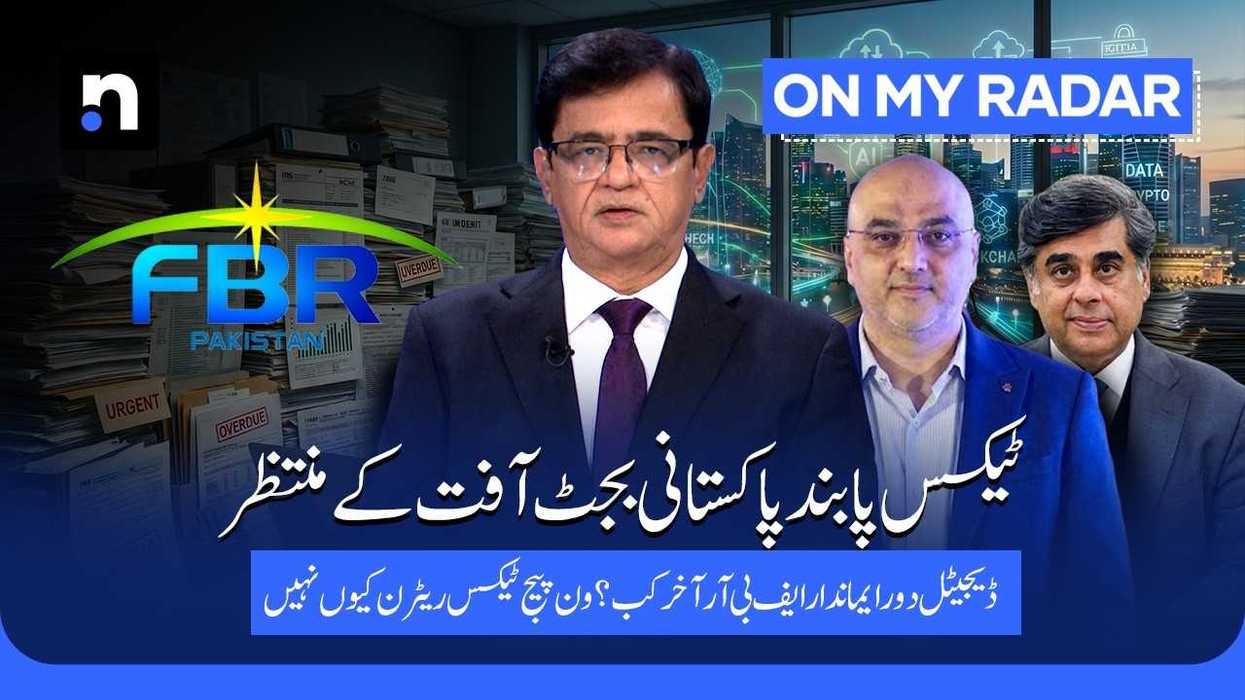
It remains uncertain whether Pakistan’s government will be able to introduce meaningful measures in the upcoming federal budget to support a weak economy, subdued growth that has remained largely stagnant for several years, and broader efforts toward business recovery.
These developments were highlighted by Kamran Khan in the latest episode of “On My Radar,” where he discussed the uncertainty surrounding the budget timeline and its broader economic implications.
As of June 2, the exact date for the federal budget announcement has still not been finalized.
Until earlier in the day, June 5 had been considered the most likely date, with the National Assembly session also convened accordingly. However, official sources have since informed the media that the budget will not be presented on June 5 and may instead be announced on June 8 or June 12—though no final date has been confirmed.
This ongoing uncertainty has fueled public speculation, with many questioning that if the government itself remains undecided on the budget date, it may reflect deeper disagreements or difficulties in finalizing the budget framework.
Unverified reports suggest that the upcoming budget is unlikely to offer significant relief or stability for taxpayers, particularly those within the documented economy.
Public concern is also growing over whether compliant taxpayers and formal businesses will once again bear the primary fiscal burden, while tax evasion in the informal sector continues largely unchecked. Questions are increasingly being raised about whether Pakistan’s outdated, complex, and widely criticized tax system will continue to disproportionately target those already within the tax net, while leaving large segments outside it largely untouched.
Pakistan’s tax regime is widely regarded by analysts as one of the most complex globally, offering limited incentives for broadening the tax base. In many countries, tax filing has been streamlined into a simple digital process completed within minutes, whereas in Pakistan the income tax return still spans more than 100 pages.
Against this backdrop, attention is now focused on whether the upcoming budget will prioritize structural tax reform and long-term economic growth, or once again rely on increasing pressure on compliant taxpayers to meet revenue targets.
In the previous budget, the government set a Federal Board of Revenue (FBR) revenue target of Rs14.13 trillion, later revised downward to Rs13.98 trillion. That figure has since been further reduced to around Rs13 trillion.
Official data shows that the FBR collected approximately Rs11.23 trillion between July and May, falling short of its revised target by Rs864 billion.
This leaves an unusually high requirement of Rs2.75 trillion for June alone—a target widely viewed by analysts as highly unrealistic.
As a result, experts believe the FBR may struggle to meet even its revised target for the third consecutive time.
Even in the previous fiscal year, the FBR missed its target by around Rs163 billion despite multiple downward revisions.
This raises a fundamental question: if revenue targets continue to be revised downward yet still remain unmet, how realistic is the newly proposed Rs15.26 trillion target for the next fiscal year?
Observers argue that the answer lies not in budgetary announcements but in Pakistan’s underlying economic structure.
Data indicates that the tax burden on salaried individuals has nearly tripled over the past four years.
In FY2022, the salaried class paid Rs189 billion in income tax. This rose to Rs606 billion in the last fiscal year and is projected to reach nearly Rs700 billion in the current year.
Meanwhile, the maximum tax rate on salaried income has climbed to approximately 38.5%, including surcharges.
At the same time, a significant portion of the economy remains outside the formal tax net, particularly within the informal sector.
In parallel, the Petroleum Development Levy (PDL) has emerged as a major revenue source for the government.
During the first 10 months of the current fiscal year, Rs1.33 trillion was collected through PDL against an annual target of Rs1.46 trillion.
For the next fiscal year, the PDL target has been set at Rs1.72 trillion. Analysts note that the levy is increasingly being used as a substitute for shortfalls in direct taxation, with its cost ultimately passed on to consumers and businesses.
Another major concern is the liquidity pressure facing the export sector.
According to the Pakistan Textile Council and industry estimates, around Rs327 billion in tax refunds remain pending with the FBR.
When advance taxes and sales tax locked in inventories are included, nearly Rs800 billion is currently stuck in the system, severely affecting working capital, export competitiveness, and fresh investment.
Against this backdrop, the Economic Policy and Business Development (EPBD) think tank has presented a shadow federal budget for FY2026–27.
EPBD argues that instead of extracting additional revenue from the already formalized sector, the government should create fiscal space to support growth and economic expansion.
It has recommended reducing the maximum income tax rate for salaried individuals to 20%, cutting the corporate tax rate from 29% to 25%, and abolishing the non-filer category entirely.
The think tank has also proposed a gradual reduction in general sales tax (GST) from 18% to 15%, along with the elimination of exemptions and SRO-based concessions, which it describes as distortionary and overly complex.
EPBD further calls for a comprehensive simplification of Pakistan’s tax filing system.
It notes that the country’s income tax return currently spans 147 pages, compared with just two pages in the United States.
With around 7 million registered tax filers but only about 3 million active taxpayers, EPBD argues that introducing a simplified one-page tax return could significantly expand the tax base and bring millions of additional individuals into the system.
Overall, analysts say Pakistan’s core fiscal challenge is not simply low revenue or high expenditure, but the persistent concentration of the tax burden on a narrow formal base, while a large informal economy remains outside the system.



Comments
See what people are discussing