

US-Iran deal talks stall amid key disputes despite claims of progress
Kamran Khan discusses shifting positions in Washington and Tehran and the growing political pressure shaping the negotiations

News Desk
The News Desk provides timely and factual coverage of national and international events, with an emphasis on accuracy and clarity.
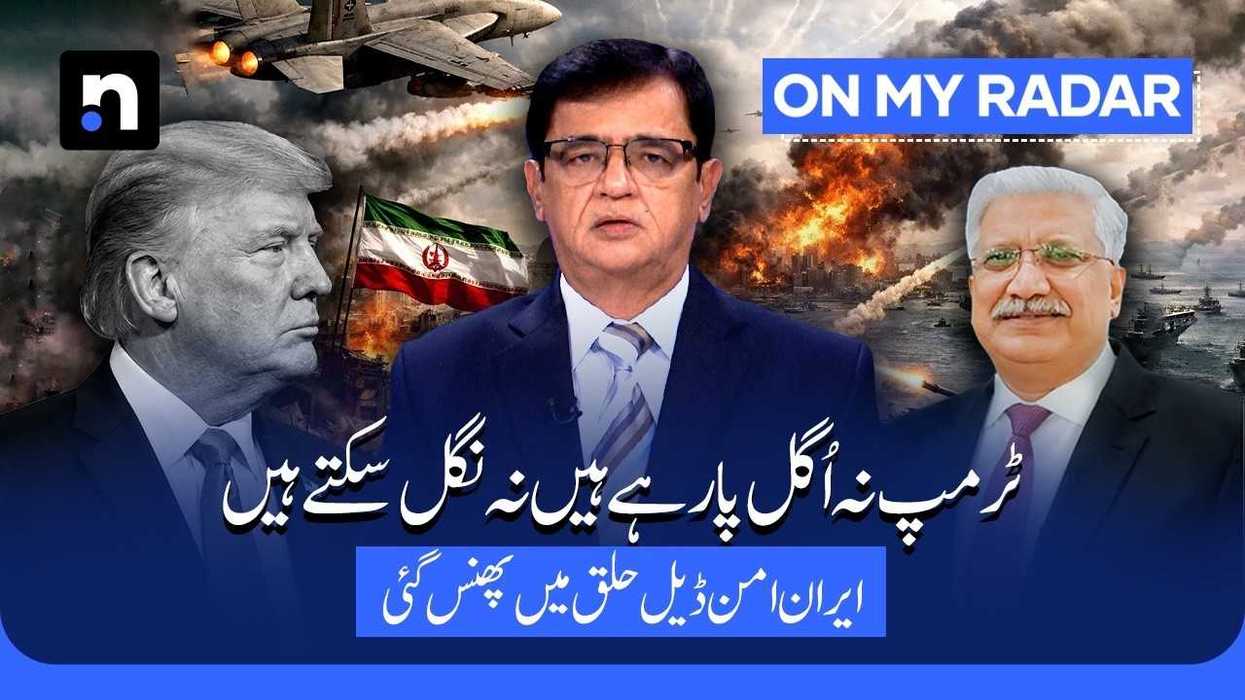
Tensions around the proposed U.S.-Iran agreement continue to deepen as negotiations remain stuck over core issues, including the Strait of Hormuz, Iran’s nuclear program and sanctions-related financial relief, even as Washington and Tehran repeatedly signal that a breakthrough may be near.
The latest developments in the unfolding diplomacy were discussed by Kamran Khan in the latest episode of "On My Radar", where he examined shifting positions in Washington and Tehran and the growing political pressure shaping the negotiations.
About a week ago, U.S. President Donald Trump again claimed that a deal with Iran was close to completion and that an end to the conflict was within reach. However, this was quickly followed by a familiar cycle of mixed messaging and reversals.
He first said the United States would not rush into any agreement, then later posted on social media that no deal had been finalized, stressing that no one had seen the text or fully understood its contents.
At the same time, Trump linked the Iran negotiations to the Abraham Accords, a move that further complicated an already sensitive diplomatic process.
The situation has now reached a stage where Trump appears politically constrained, unable to fully endorse the agreement or walk away from it.
Trump’s shifting signals deepen uncertainty over Iran deal
On Friday, he announced a key meeting with his war cabinet to take a final decision on the Iran file, also sharing proposed conditions ahead of the session on social media.
However, despite a reportedly lengthy meeting, no formal announcement followed.
Subsequent reports suggested that Trump had hardened the proposed terms and sent them back to Tehran for further review.
He is now seeking stronger guarantees on Iran’s nuclear commitments and clearer terms regarding the reopening of the Strait of Hormuz.
As a result, what was once portrayed as a near-final agreement has again become politically complex, even for a leader who often describes himself as a master negotiator.
Yet in a Fox News interview on Saturday, Trump insisted the United States was still “very close to a very good deal with Iran,” raising fresh questions about the actual state of negotiations.
If the deal is truly close, the central question remains: where do the key differences persist?
Strait of Hormuz dispute remains key sticking point
According to media reports, although the memorandum of understanding is reportedly brief, at least three major disputes continue to block progress.
The first concerns the Strait of Hormuz. Trump is pushing for its immediate reopening with no restrictions or fees on global shipping. Iran, however, insists its future status should be jointly determined by Iran and Oman, under conditions set by Tehran.
Nuclear program and asset freeze deepen divide
The second issue is Iran’s nuclear program. Trump is demanding binding assurances that Iran will never develop a nuclear weapon and has suggested the removal and destruction of enriched material. Iran, however, maintains that its nuclear program is not part of the current negotiations.
The third dispute involves financial arrangements. Trump says the agreement includes no provision for releasing frozen Iranian assets or easing sanctions, while Iran claims there is already a preliminary understanding on unlocking nearly $12 billion in frozen funds.
Tehran also insists that economic relief and asset recovery must form a central pillar of any final deal.
Mohammad Bagher Ghalibaf, who leads Iran’s negotiating team, has said Tehran will not accept any agreement that fails to deliver tangible benefits to its people, adding that Iran will not move forward unless Washington first takes concrete steps.
Meanwhile, domestic political pressure is mounting on Trump in the United States as the economic and strategic costs of the standoff become more visible.
Analysts say the White House is now attempting to frame the outcome in a way that avoids the perception of strategic failure.
Robert Kagan, a foreign policy expert at the Brookings Institution, has described the current trajectory as a setback for Trump, arguing that the administration is trying to present it as a diplomatic success.
In a recent article, Kagan wrote that “Trump’s ultimate goal is actually surrender,” suggesting the president is seeking to package the outcome in a way that avoids public perception of defeat.
At the same time, prominent Republican lawmakers, including Lindsey Graham, Ted Cruz, Roger Wicker and Mike Pompeo, have warned against any deal that offers Tehran excessive concessions or fails to meaningfully curb its nuclear and regional ambitions.
A ceasefire in Lebanon also remains one of Iran’s key conditions, with tensions in the region yet to fully subside.
Pakistan plays quiet diplomatic role amid talks
Amid these complex negotiations, Pakistan continues to play a diplomatic role. On Friday, U.S. Secretary of State Marco Rubio, during a meeting with Pakistan’s Deputy Prime Minister and Foreign Minister Ishaq Dar, acknowledged Islamabad’s efforts to help ease tensions with Iran.
Iranian President Masoud Pezeshkian also expressed appreciation for Pakistan’s diplomatic engagement, saying Islamabad had played a constructive role in facilitating dialogue.
The broader question now is whether Washington and Tehran can bridge their deep-rooted differences.
Core issues such as the Strait of Hormuz, Iran’s nuclear program and financial relief remain unresolved.
Until these gaps are closed, each claim of progress is likely to be followed by renewed uncertainty.
That is why, even as both sides repeatedly suggest a deal is close, a final agreement continues to remain elusive.





Comments
See what people are discussing