

Pakistan’s policy uncertainty threatens investment and economic growth
Weak exports, low foreign investment and policy reversals are undermining recovery, industrial growth and investor confidence, Kamran Khan says

News Desk
The News Desk provides timely and factual coverage of national and international events, with an emphasis on accuracy and clarity.
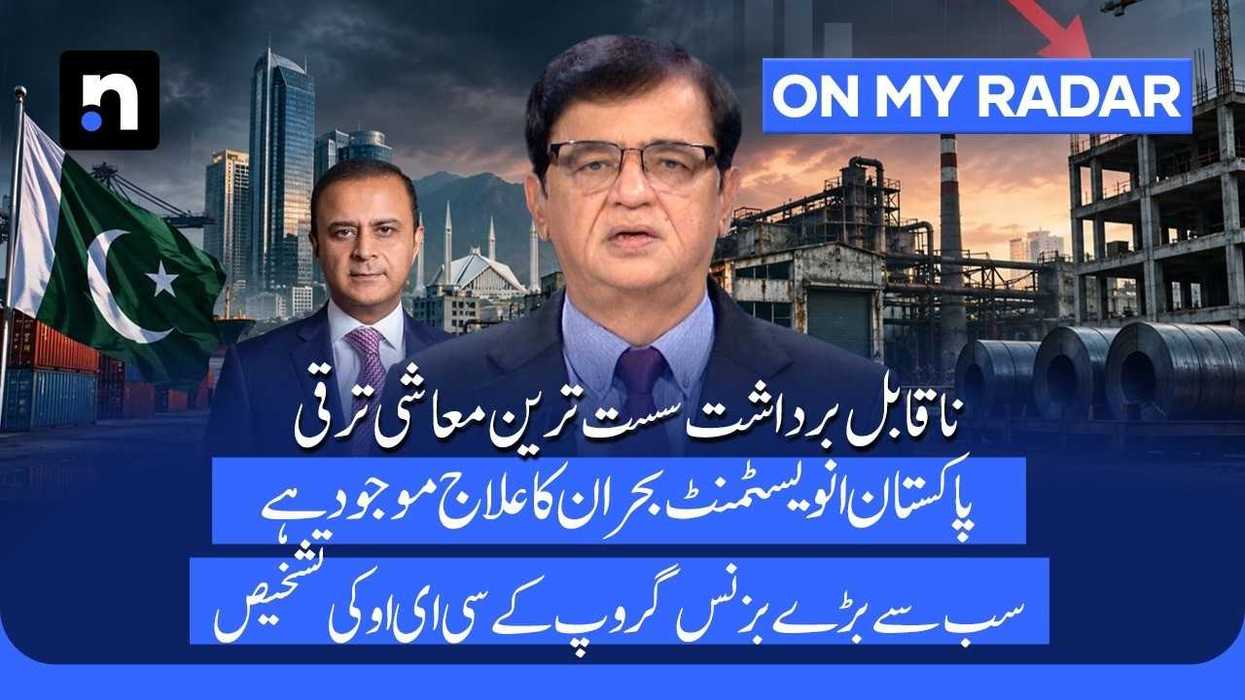
Pakistan has avoided an immediate threat of economic default, but weak exports, declining investor confidence and frequent government policy changes are preventing the country from achieving sustainable economic growth, Kamran Khan said in his latest episode of On My Radar.
Three economic indicators highlight the scale of the challenge: Pakistan's average economic growth over the past five years has remained around 3%, annual exports have stagnated at approximately $30 billion for several years, and foreign direct investment amounted to just $1.6 billion in 2026.
These figures reflect an economy struggling to keep pace with its rapidly growing population. Industrial expansion remains weak, investors are reluctant to commit capital, and unemployment has climbed to 7.1%, its highest level in 21 years.
Young people are increasingly leaving the country in search of opportunities, while World Bank figures indicate that approximately 70 million Pakistanis live in poverty.
Stagnant exports increase pressure on foreign exchange reserves and deepen reliance on borrowing, while low foreign investment raises questions about the country's long-term economic prospects.
Economic stability has yet to translate into growth
Pakistan has made progress toward macroeconomic stability after moving away from the immediate threat of default. Foreign exchange reserves have reached approximately $21.5 billion, while inflation has fallen to single digits.
Remittances have become a major source of foreign exchange. Pakistan received $14.8 billion in remittances between July and October, while the State Bank of Pakistan has set a target of $45 billion for the full fiscal year.
The country also made $14.4 billion in debt repayments in fiscal year 2026.
These developments have helped improve international financial confidence. S&P and Moody's upgraded Pakistan's credit ratings, while the country successfully issued $3 billion in Eurobonds, attracting offers worth approximately $6 billion.
Foreign investment in government securities, including Treasury bills and Pakistan Investment Bonds, exceeded $747 million over four months.
However, avoiding default and stabilizing financial indicators are not the same as achieving economic growth. Pakistan's real challenge is to expand exports, increase industrial production and attract long-term foreign investment.
Former finance minister Hafeez Sheikh has also highlighted Pakistan's failure to attract foreign direct investment and expand exports as major weaknesses in its economic performance.
Policy inconsistency undermines investor confidence
Economic experts identify frequent policy changes as a major obstacle to investment and industrial growth.
Foreign investors remain reluctant to enter Pakistan, while domestic businesses continue to face uncertainty over government policies, high operating costs and a complicated tax system.
Reforms at the Federal Board of Revenue, a simpler taxation structure and consistent economic policies are essential to restoring investor confidence.
Recent developments in the automotive and refinery sectors illustrate how sudden policy changes can create uncertainty for businesses planning long-term investments.
New auto policy raises concerns for manufacturers
Pakistan's new automotive policy aims to increase the share of electric and new-energy vehicles to 30% of total vehicle sales by 2030.
The proposals include introducing an Automotive Development Levy on petrol and diesel vehicles for the first time in the country's history. They also suggest sales tax rates ranging from 1% to 9% for electric vehicles, compared with 18% for petrol and diesel vehicles.
Industry representatives warn that the proposed measures could hurt demand for conventional vehicles, disrupt local auto-parts manufacturing and undermine efforts to increase localization.
According to industry concerns highlighted on the program, approximately 1,200 auto-parts businesses and hundreds of thousands of jobs could be at risk.
Automotive industry expert Suneel Munj warned that frequent policy reversals have kept Pakistan's automotive industry weak.
Refinery policy changes threaten billions in investment
The refinery sector is facing similar uncertainty following an abrupt change in the mechanism used to determine petrol prices.
The Petroleum Division directed refineries to implement a new pricing formula approved by the federal Cabinet, raising concerns among refinery management about potential financial losses.
Refineries estimate that the revised mechanism could cost them as much as 49 rupees per liter.
They also argue that the government introduced the changes without consulting the industry and disregarded earlier commitments to support refinery upgrades.
The development has raised concerns about investment plans involving the country's four refineries, which have signed agreements for projects worth approximately $5 billion to $6 billion to modernize their facilities.
Industry representatives fear that repeated policy changes could make these projects financially unviable and discourage further investment.
Security concerns threaten Pakistan's mineral investment ambitions
Beyond policy uncertainty, terrorism remains a major obstacle to economic development, particularly in resource-rich Balochistan.
Pakistan is seeking billions of dollars in foreign investment in copper, gold and other critical minerals. The Pakistan Minerals Investment Forum began on Thursday, aiming to attract international investors and showcase the country's mineral potential.
Last year's forum attracted more than 5,000 delegates from over 50 countries and resulted in the signing of 16 memorandums of understanding.
The US Export-Import Bank has also approved $1.25 billion in financing that could support up to $2 billion in American mining equipment and services exports and sustain approximately 13,500 jobs in the United States and Pakistan.
However, security concerns continue to complicate these ambitions. No American company is currently operating in Balochistan, while terrorist attacks have disrupted supply routes serving the Saindak mining project.
The Reko Diq project is also facing security-related challenges.
Pakistan's ranking at the top of the Global Terrorism Index 2026 has further heightened concerns among international investors considering projects in the country.
The combination of security threats and unpredictable economic policies risks undermining Pakistan's efforts to attract the investment needed to develop its mineral resources.
The central challenge for policymakers is to turn economic stabilization into sustainable growth. Without consistent policies, a competitive business environment, stronger exports and improved security, Pakistan will struggle to attract investment, create jobs and provide economic opportunities for its growing population.



Comments
See what people are discussing