

Pakistan, China reaffirm strategic partnership and agree to advance CPEC Phase II
PM Sharif and Premier Li Qiang agreed to advance CPEC Phase II in Beijing, launching five new development corridors covering AI, green energy and agriculture

News Desk
The News Desk provides timely and factual coverage of national and international events, with an emphasis on accuracy and clarity.
Aamir Abbasi
Editor, Islamabad
Aamir; a journalist with 15 years of experience, working in Newspaper, TV and Digital Media. Worked in Field, covered Big Legal Constitutional and Political Events in Pakistan since 2009 with Pakistan’s Top Media Organizations. Graduate of Quaid I Azam University Islamabad.
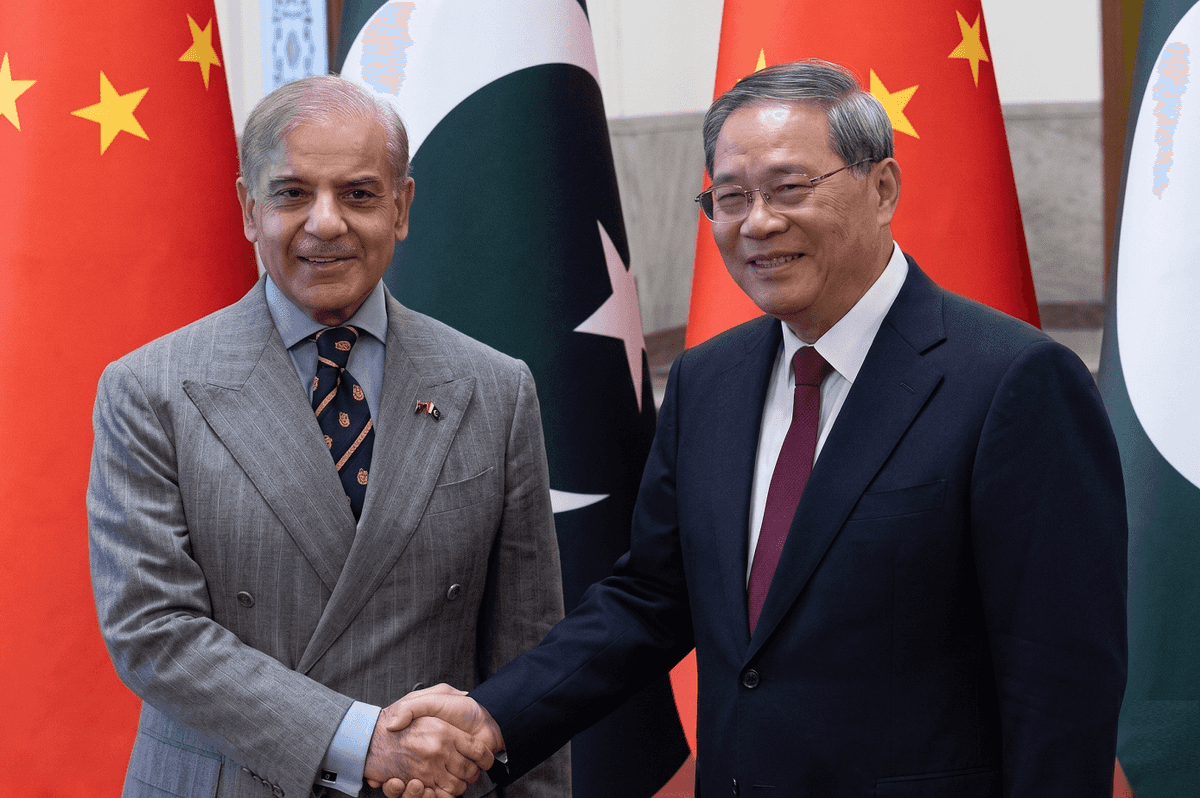
Pakistan Prime Minister Shehbaz Sharif meets Chinese Premier Li Qiang in Beijing on Monday.
Screengrab
Pakistan Prime Minister Shehbaz Sharif and Chinese Premier Li Qiang reaffirmed their strategic partnership on Monday and agreed to accelerate the next phase of the China-Pakistan Economic Corridor, as both countries marked 75 years of diplomatic relations.
Sharif was received at the Great Hall of the People with a formal guard of honor before holding delegation-level talks with Li. The meeting confirmed that CPEC Phase II would expand into five new development corridors.
What was agreed on CPEC Phase II during the Pakistan-China Beijing talks?
Both sides agreed to officially advance CPEC Phase II, shifting focus from basic infrastructure to industrialisation, agriculture modernisation, green energy, artificial intelligence and digital transformation.
The upgraded phase is structured around five new corridors: the Growth Corridor, Livelihood Corridor, Innovation Corridor, Green Corridor, and Open and Inclusive Regional Development Corridor. Leaders also emphasized accelerating priority projects including the ML-1 railway modernization and the full operationalization of Gwadar Port.
What are Pakistan's priorities for CPEC Phase II?
Sharif outlined Pakistan's priorities for the corridor's next phase, including industrial development, connectivity, agriculture, science and technology, digital transformation and clean energy.
He also urged greater alignment between China's 15th Five-Year Plan and Pakistan's "Uraan Pakistan" development framework to enhance economic integration and long-term growth. Multiple memorandums of understanding targeting IT, artificial intelligence and agriculture technology were signed to boost direct business-to-business investment.
Both sides reaffirmed support for each other on core national interests and acknowledged CPEC's central role in Pakistan's development. They agreed to maintain high-level engagement and advance bilateral relations into a more "results-oriented and high-quality" phase of cooperation.
Sharif described China as a cornerstone of Pakistan's foreign policy, saying the relationship was built on "mutual trust, strategic confidence and shared aspirations for peace and development."
What new areas of cooperation did Pakistan and China agree on?
The discussions covered emerging sectors including artificial intelligence, space exploration and advanced technologies. Sharif said Pakistan's participation in China's space station programme through selected astronauts reflected deepening strategic cooperation in high-tech sectors. Both governments also agreed to give renewed momentum to people-to-people exchanges and closer coordination in the coming years.
Sharif stressed that the 75th anniversary should be used to convert historic ties into "practical, people-centric and future-oriented outcomes."
He also appreciated Beijing's continued support for Pakistan's economic stability and reiterated Islamabad's commitment to ensuring the security of Chinese nationals, projects and institutions operating in the country. Both sides agreed to expedite ongoing initiatives across political, economic, security and development sectors.
What role did Field Marshal Asim Munir play in the Beijing meetings?
Pakistan's Chief of Defence Forces and Army Chief, Field Marshal Asim Munir, attended the Beijing talks after concluding a visit to Iran over the weekend alongside Interior Minister Mohsin Naqvi. His presence underscored Islamabad's parallel diplomatic outreach amid wider regional tensions involving Iran and the United States.
China has called for stability in the Middle East and previously said it would work with Pakistan to contribute to "the early restoration of peace and stability" in the region.
Sharif told Chinese leaders that the international community was facing a "critical moment," adding that Pakistan had played a facilitative role in contacts between Washington and Tehran.
"Pakistan has played a sincere role to mediate between the US and Iran," he said. "Things are moving in the right direction. I would like to thank China's support to promote peace."
With additional input from AFP


Comments
See what people are discussing