

Pakistan army chief holds talks in Iran amid mediation efforts to end US war
Field Marshal Asim Munir's Tehran visit wrapped with "encouraging progress" reported by Pakistan's military, as US-Iran talks remain at a critical juncture

News Desk
The News Desk provides timely and factual coverage of national and international events, with an emphasis on accuracy and clarity.
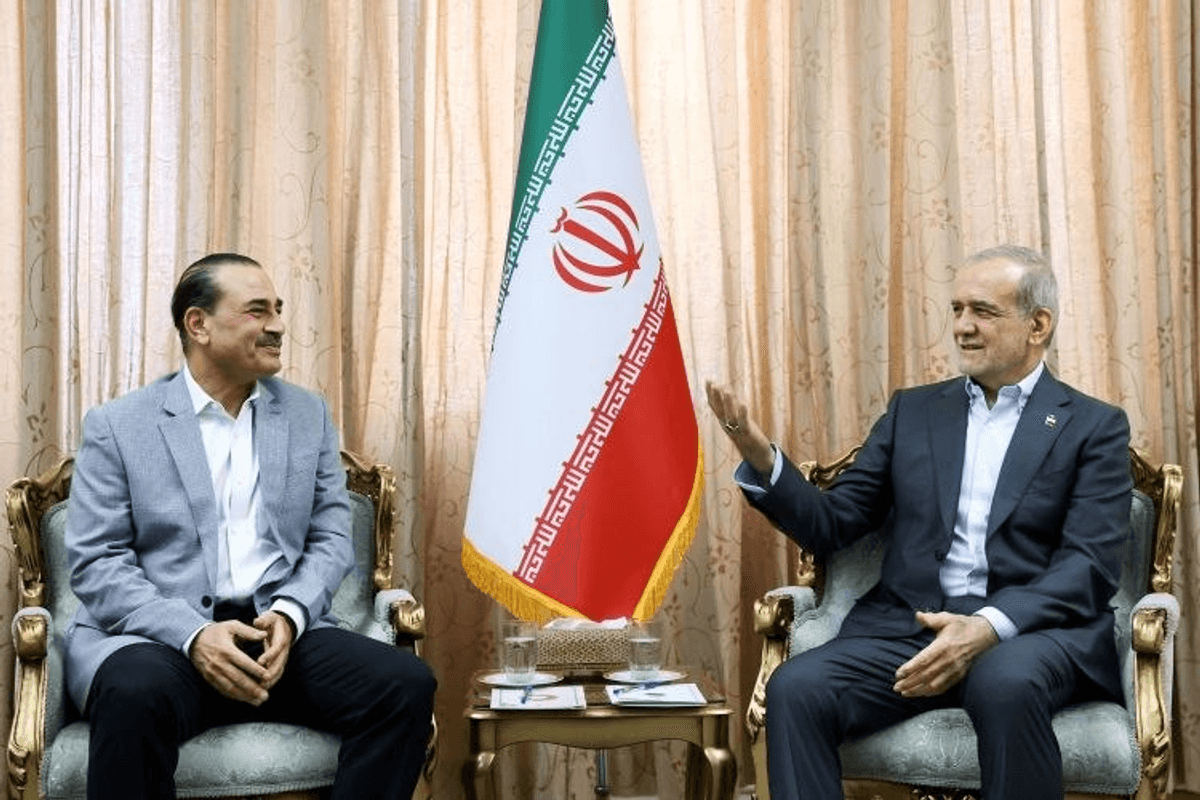
Pakistan's army chief Field Marshal Asim Munir meets Iranian President Masoud Pezeshkian in Tehran.
Iran_GOV/X
Pakistan's army chief Field Marshal Asim Munir concluded a two-day visit to Tehran on Saturday after holding high-level meetings with Iranian leaders aimed at supporting dialogue between Iran and the United States.
Pakistan's military described the visit as "highly productive", saying encouraging progress had been made toward a broader understanding.
What did Pakistan's army chief achieve in Tehran?
Pakistan's Inter-Services Public Relations said the meetings took place in a "positive and constructive environment" and contributed to ongoing diplomatic consultations.
The ISPR added that "encouraging progress" had been made toward a broader understanding and that Iranian leadership appreciated Pakistan's role in promoting peaceful resolution of regional disputes. Munir met Iranian President Masoud Pezeshkian, Parliament Speaker Mohammad Bagher Ghalibaf, Foreign Minister Abbas Araghchi and Interior Minister Eskandar Momeni.
What is Pakistan's role in US-Iran diplomacy?
In recent months, Islamabad has positioned itself as a channel for indirect communication between Washington and Tehran, including hosting rare direct contacts earlier this year, according to officials familiar with the matter.
US Secretary of State Marco Rubio said on Thursday he hoped Pakistani efforts would help advance negotiations, adding that Pakistani representatives were expected to travel to Tehran as part of ongoing contacts. President Donald Trump has described talks as hovering at a "borderline" stage between a possible agreement and renewed military escalation.
The Tehran visit also coincides with broader Pakistani diplomatic activity, with Prime Minister Shehbaz Sharif undertaking a separate visit to China focused on economic and strategic cooperation.
Where do Iran-US negotiations stand after the ceasefire?
Diplomatic engagement between Washington and Tehran has continued intermittently since the April 8 ceasefire halted fighting between the United States, Israel and Iran.
Both sides have exchanged proposals, but key differences remain unresolved. Iranian officials, including Baqaei, have said Tehran is reviewing US proposals while maintaining demands related to frozen assets and maritime restrictions.
Concerns have also persisted over the Strait of Hormuz, a critical global energy route where earlier disruptions continue to affect shipping flows and insurance costs. Iran has maintained heightened security measures in the waterway. Regional actors, including the United Arab Emirates, have raised concerns over potential unilateral changes to navigation arrangements in the strategic corridor.



Comments
See what people are discussing