

Gulf states push diplomacy as Trump delays possible Iran attack
Kamran Khan says Arab leaders warned Washington that a strike on Iran could destabilize the entire Middle East.

News Desk
The News Desk provides timely and factual coverage of national and international events, with an emphasis on accuracy and clarity.
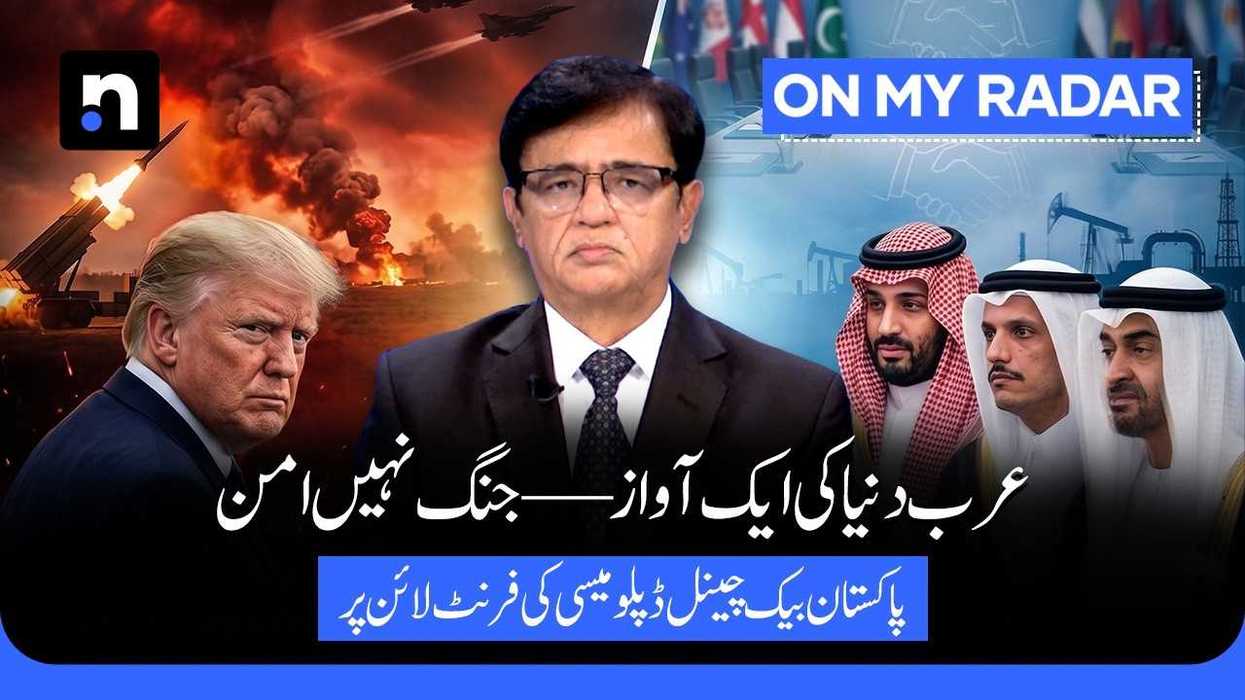
Kamran Khan says Saudi Arabia, Qatar and the United Arab Emirates jointly urged U.S. President Donald Trump to delay a possible military strike on Iran as regional mediation efforts intensified to prevent a wider conflict in the Middle East.
Speaking on his show “On My Radar,” Khan said the past 24 hours had brought a “positive development” after nearly two months of tensions surrounding a possible U.S.-Iran war.
According to Khan, Saudi Crown Prince Mohammed bin Salman, Qatari Prime Minister Mohammed bin Abdulrahman Al Thani and UAE President Mohammed bin Zayed Al Nahyan collectively appealed to Trump to postpone what Khan described as a planned major U.S. attack on Iran scheduled for Tuesday.
Khan said Trump agreed to delay the operation for three days after requests from Saudi Arabia, Qatar and the UAE.
According to Khan, Trump was told by Gulf leaders that “serious negotiations” with Iran were underway and that a potential agreement acceptable to both Washington and the broader Middle East could still be achieved.
Khan said Pakistan was also actively involved in mediation efforts aimed at ending the crisis and had received support from the United States, Iran and regional Arab states.
He said Pakistani Prime Minister Shehbaz Sharif and the Qatari prime minister had spoken by telephone three times over the past three days as diplomatic contacts intensified.
Khan also cited comments from Qatar’s Foreign Ministry spokesperson, who said Doha supported Pakistan’s diplomatic efforts and believed more time should be given to negotiations between the parties.
Pakistan Interior Minister Mohsin Naqvi recently completed a three-day visit to Iran, where he met senior Iranian leaders, including President Masoud Pezeshkian, Khan said.
According to Khan, Naqvi also acted as an intermediary in communications between Washington and Tehran during the visit.
Khan said mediation efforts by Pakistan and Gulf countries contributed to Trump’s last-minute decision to halt a possible strike on Iran.
However, he added that Trump warned on his Truth Social platform that the United States could still launch a “full-scale assault” if negotiations failed.
Khan cited U.S. media reports saying Iran’s proposed peace framework still did not fully satisfy Washington’s demands.
At the same time, Saudi Arabia, Qatar and the UAE were increasing pressure on Washington to keep negotiations alive, Khan said.
Referring to a report by Axios, Khan said Trump spoke by phone with leaders from Saudi Arabia, Qatar and the UAE before postponing the possible military action.
He also cited an unnamed U.S. official as saying Doha, Abu Dhabi and Riyadh delivered a unified message warning that the entire region could pay the price if Iran were attacked.
According to Khan, Gulf leaders fear any Iranian retaliation could target regional oil and energy facilities.
He also referred to a report by Reuters suggesting Iranian officials had indicated Washington may be softening some of its demands.
Khan said the United States appeared willing to release part of Iran’s frozen assets and show flexibility regarding peaceful nuclear activities.
Iranian President Pezeshkian has also acknowledged publicly for the first time that Iran is facing “serious challenges” and has suffered damage from the ongoing tensions, Khan said.
Khan said the region now faces two parallel realities: the continuing threat of war and rapidly expanding back-channel diplomacy aimed at securing a new agreement between Washington and Tehran.




Comments
See what people are discussing