


News Desk
The News Desk provides timely and factual coverage of national and international events, with an emphasis on accuracy and clarity.
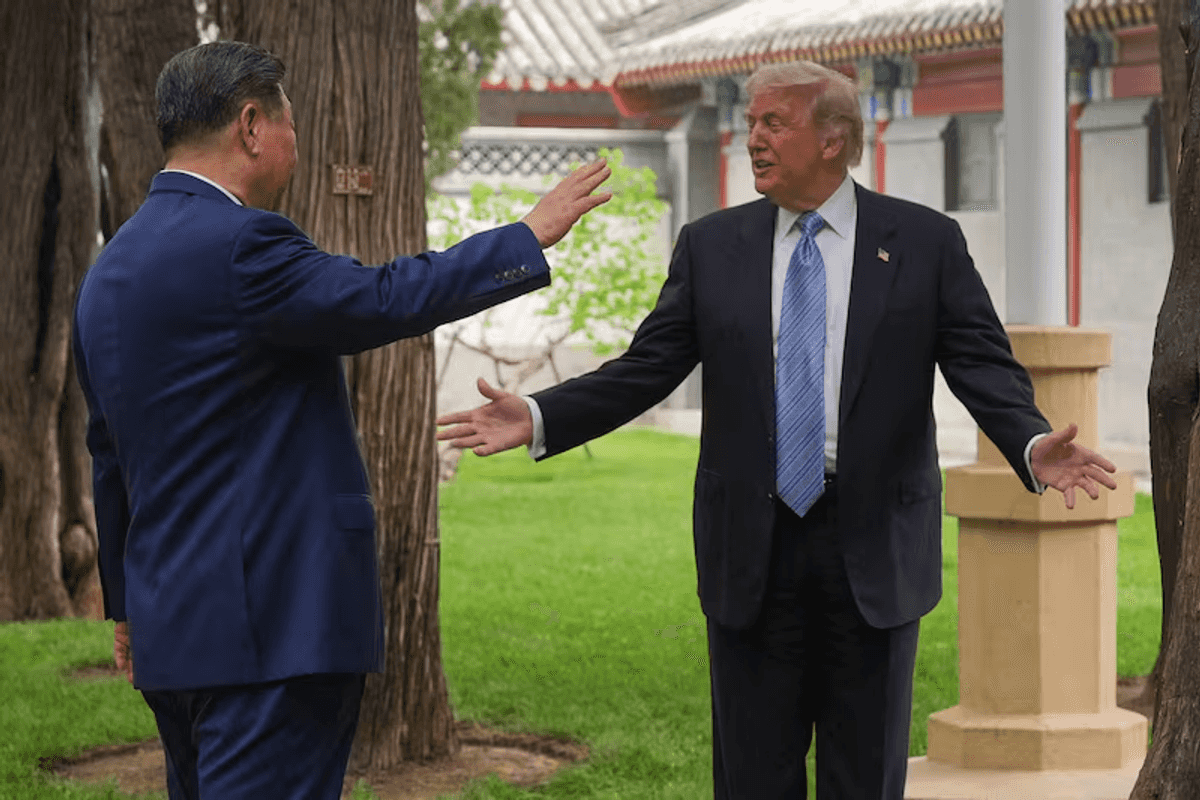
US President Donald Trump talks with China’s President Xi Jinping at the Zhongnanhai leadership compound, Friday, May 15, 2026, in Beijing.
Reuters
US President Donald Trump said on Friday that Chinese President Xi Jinping had agreed Iran must reopen the Strait of Hormuz, though China gave no indication it would directly pressure Tehran to do so.
Flying back from Beijing after two days of talks, Trump also said he was considering lifting US sanctions on Chinese oil companies buying Iranian crude, Reuters reported.
China's foreign ministry called the Iran war a conflict that "should never have happened" and had "no reason to continue."
What did Trump and Xi agree on regarding the Strait of Hormuz?
Trump said Xi agreed the strait must be reopened and that Iran cannot be allowed to acquire a nuclear weapon.
China stopped short of committing to press Iran directly. When asked whether Xi had made a firm commitment to pressure Tehran, Trump said: "I'm not asking for any favors because when you ask for favors, you have to do favors in return."
Why is the Strait of Hormuz central to the Iran conflict?
Iran effectively shut the strait after the US and Israel launched attacks on February 28, cutting off a waterway that previously carried one-fifth of the world's oil and liquefied natural gas supply.
The disruption has triggered the biggest oil supply crisis in history, sending prices skyrocketing. Oil rose around 3% to approximately $109 a barrel on Friday as concerns over a lack of progress in the conflict deepened.
US Treasury yields also hit their highest level in around a year on expectations the Federal Reserve might need to raise interest rates in response. The US paused its attacks last month but imposed a port blockade on Iran. Tehran has said it will not unblock the strait until the US ends that blockade, and Trump has threatened to resume attacks if Iran refuses to agree to a deal.
"We don't want them to have a nuclear weapon, we want the straits open," Trump said in Beijing alongside Xi.
Where do Iran nuclear talks stand?
Talks on ending the war have been on hold since last week, when Iran and the US each rejected the other's most recent proposals.
The conflict has become a domestic liability for Trump ahead of November's congressional elections, with his Republican Party struggling to maintain control of Congress. Trump told Fox News on Thursday that he was losing patience, and said Iran "should make a deal."
Iran's Foreign Minister Abbas Araqchi said Tehran had received messages from Washington indicating the US was willing to continue talks. He told reporters in New Delhi that he hoped negotiations would advance to a point where the Strait of Hormuz could be fully secured and traffic through it normalized.
Iran would welcome Chinese involvement in the process, he added, though he said Tehran did not trust the US, which had launched air strikes during previous rounds of diplomacy.
Iran has long denied any intention to build a nuclear weapon and has refused to end nuclear research or relinquish its hidden stockpile of enriched uranium.
China is the largest buyer of Iranian oil, giving Beijing potential leverage, though Xi did not publicly comment on his discussions with Trump about Iran. Thousands of Iranians have been killed in US and Israeli air strikes since February 28, and thousands more have died in renewed fighting between Israel and Iran-backed Hezbollah in Lebanon.


Comments
See what people are discussing