

Saudi-led push for Iran peace deal could reshape Middle East order
Kamran Khan says Saudi Arabia is leading efforts for a new regional peace framework after the war

News Desk
The News Desk provides timely and factual coverage of national and international events, with an emphasis on accuracy and clarity.
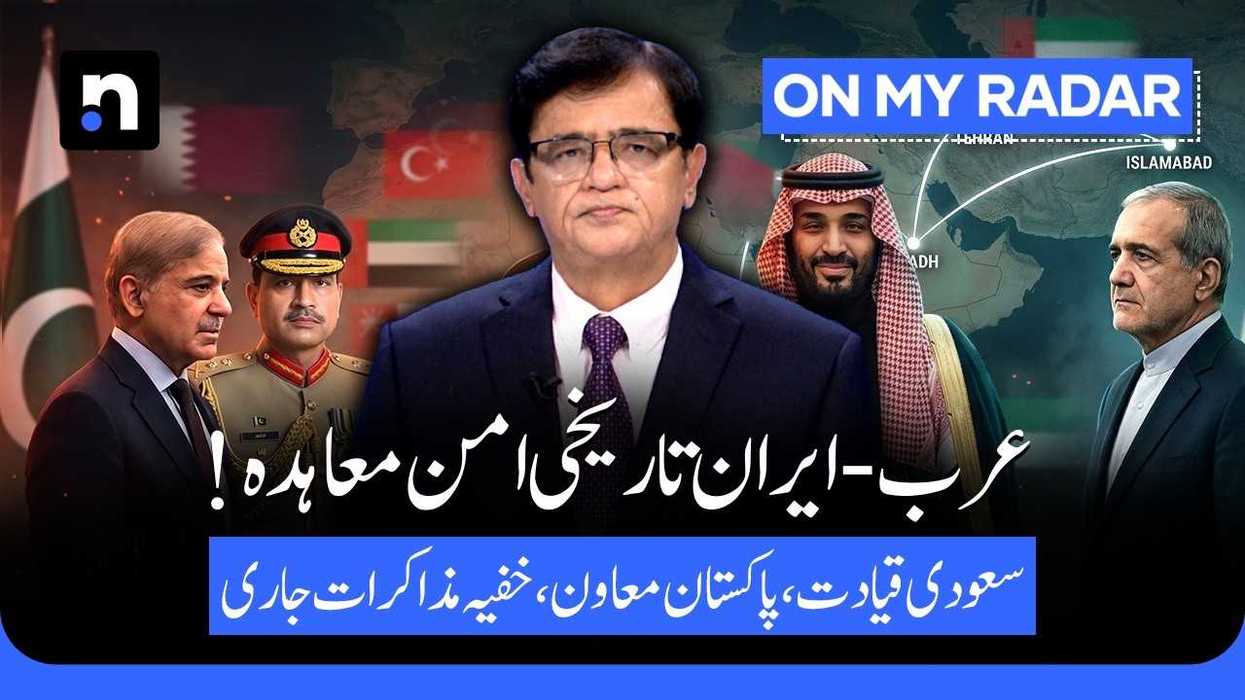
Kamran Khan says the conflict involving Iran, Israel and the United States has shaken the Middle East’s political order, forcing Arab states to rethink how lasting peace can be established across the region.
Speaking during an episode of “On My Radar,” Khan cited a report by the Financial Times saying Saudi Arabia and allied Gulf countries are working on a possible peace proposal with Iran aimed at reducing tensions after the war and preventing future conflicts.
According to diplomatic sources quoted in the report, Saudi Arabia is examining Europe’s 1970s-era Helsinki Process as a possible model for regional peace.
The Helsinki framework, established during the Cold War, helped reduce tensions between rival powers in Europe through dialogue and confidence-building measures.
Khan said Gulf states are increasingly concerned that even a weakened Iran could continue to pose security risks to neighboring countries after the conflict, particularly if the United States reduces its military presence in the region in the future.
The Financial Times report also said several European countries and the European Union support the Saudi initiative and ongoing backchannel diplomacy, viewing it as a possible path to avoiding future wars.
A significant development emerged in New Delhi when Iranian Foreign Minister Abbas Araghchi confirmed reports that Russia had offered to transfer Iranian uranium.
Araghchi said the matter was discussed with Russian President Vladimir Putin during a recent visit to Moscow and could become part of future negotiations with the United States.
Iran has repeatedly said it has no intention of developing nuclear weapons, a position Khan described as a sign of possible flexibility from Tehran following the conflict.
An unnamed Arab diplomat quoted by the Financial Times said many Arab and Muslim countries could respond positively to a Helsinki-style agreement for the Middle East.
However, the diplomat also questioned whether Israel could be incorporated into such a framework amid growing anger across the Arab world over Israeli military actions in Gaza, Lebanon and Syria.
According to Khan, some Arab and Muslim countries increasingly view Israel as a destabilizing force in the region following recent conflicts.
Khan said Saudi Arabia is playing a central leadership role in the current peace efforts and that Pakistan is supporting the process diplomatically.
He said Pakistan’s Deputy Prime Minister and Foreign Minister Ishaq Dar has remained in close contact with the Saudi leadership, while Gulf countries continue supporting Pakistan’s mediation efforts aimed at ending the Iran-U.S. conflict.
Khan also said Pakistan is rapidly emerging as a more influential player in the region’s evolving geopolitical landscape.
He pointed to growing strategic coordination among Saudi Arabia, Pakistan, Turkey and Qatar.
Last September, Saudi Arabia and Pakistan signed a defense agreement. Khan said Pakistan’s Defense Minister Khawaja Asif has since indicated that Turkey and Qatar could also join the framework as part of a broader economic and defense alliance aimed at reducing external dependence.
Khan said the Financial Times report suggests the Middle East is already preparing for a new geopolitical reality after the war.
He said the coming months could see the emergence of new alliances, fresh security structures and diverging political and economic trajectories among Gulf nations.


Comments
See what people are discussing